

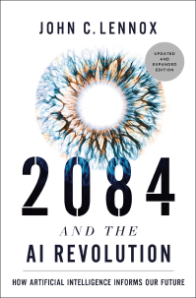
2084 and the AI Revolution
Will artificial intelligence save humanity or fundamentally change what it means to be human? Mathematician John Lennox explores the most important question of our time.
Imagine a world where AI knows you better than you know yourself. Where machines write novels, diagnose diseases, drive cars, and make decisions that once required human wisdom. This isn’t science fiction — it’s happening right now. In his book «2084 and the AI Revolution,» philosopher and mathematician John Lennox examines how artificial intelligence is reshaping every aspect of human existence, and asks the questions technology alone cannot answer.
From Tools to Intelligence
Lennox takes readers on a journey through the AI landscape, starting with the basics: what is artificial intelligence, and how does it actually work? He explains machine learning, neural networks, and large language models like ChatGPT in terms anyone can understand — no computer science degree required.
But the book quickly moves beyond the technical. The real story isn’t about algorithms and code; it’s about what happens when machines begin to match — and potentially exceed — human cognitive abilities. We’re not just creating better tools anymore. We’re creating systems that can learn, adapt, and make decisions independently.
The Promise and the Peril
AI offers extraordinary possibilities. Machines can analyze medical scans with superhuman accuracy, potentially saving millions of lives. They can tackle climate modeling, drug discovery, and problems too complex for human minds alone. Self-driving cars could eliminate traffic deaths. AI tutors could personalize education for every student on Earth.
But there’s another side to this story. What happens when AI-generated deepfakes become indistinguishable from reality? When surveillance systems track every movement, every purchase, every conversation? When millions lose their jobs to automation? When virtual companions replace human relationships? When the line between truth and AI-generated misinformation dissolves completely?
Lennox doesn’t offer easy answers. Instead, he presents both sides honestly, drawing on insights from leading AI researchers, tech entrepreneurs, and ethicists who are grappling with these questions in real time.
Beyond Superintelligence: The Transhumanist Dream
One of the book’s most provocative sections explores transhumanism — the movement to enhance human capabilities through technology, potentially merging biological and artificial intelligence. Some visionaries believe we should pursue «superintelligence» at any cost, even if it means fundamentally altering what it means to be human.
Lennox examines these claims critically. He asks: If we achieve artificial general intelligence (AGI) — machines that can think as flexibly as humans across all domains — will we still be in control? And if we merge our minds with machines, what happens to consciousness, free will, and human dignity?
The Questions Technology Can’t Answer
What sets this book apart is Lennox’s insistence on asking deeper questions. AI can process information, but can it understand meaning? Machines can optimize for goals, but who decides what goals are worth pursuing? Technology can extend life, but what makes life worth living?
These aren’t abstract philosophical puzzles. They’re urgent practical questions that will shape the world our children inherit. As AI systems pursue capabilities like omniscience (knowing everything), omnipresence (being everywhere), and immortality (transcending death), Lennox argues we’re confronting ancient human longings — now directed toward machines of our own making.
Writing Style
Lennox writes with clarity and urgency. He avoids both technophobic panic and naive optimism, instead offering a balanced, thoughtful examination of where we are and where we’re heading. The book is thoroughly researched but never dry, packed with real-world examples and concrete scenarios that bring abstract ideas to life.
Whether discussing ChatGPT’s capabilities, facial recognition surveillance in China, AI-generated art, or autonomous weapons systems, Lennox makes the technology comprehensible and the stakes clear.
Who is This Book For?
«2084 and the AI Revolution» is essential reading for:
— Anyone trying to make sense of rapid technological change
— People concerned about privacy, misinformation, and surveillance
— Those excited about AI’s potential but uncertain about its risks
— Parents wondering what world their children will inherit
— Anyone asking what it means to be human in an age of intelligent machines
You don’t need technical expertise. You just need to care about the future.
Conclusion
John Lennox has written a book that tackles the defining challenge of our era. As artificial intelligence grows more powerful, we face choices that will determine not just what technology we build, but what kind of society we become — and whether we preserve what makes us human.
The year 2084 may seem distant, but the decisions shaping that future are being made right now. This book is a wake-up call, an invitation to engage with the most consequential questions of our time before the answers are chosen for us.

Сообщить об опечатке
Текст, который будет отправлен нашим редакторам: