

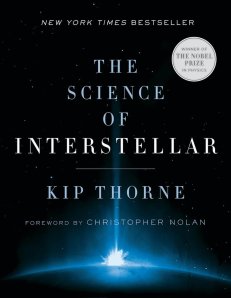
The Science of Interstellar
Can a blockbuster movie be scientifically accurate? Nobel Prize-winning physicist Kip Thorne proves it’s not only possible — it’s breathtaking.
Black holes that bend time. Wormholes connecting distant galaxies. Planets orbiting in the shadow of a supermassive singularity where one hour equals seven years on Earth. These aren’t just stunning visual effects from Christopher Nolan’s film «Interstellar» — they’re grounded in real physics. In «The Science of Interstellar,» Kip Thorne, the film’s scientific consultant and executive producer, reveals the extraordinary science behind one of cinema’s most ambitious space epics.
When Science Shapes the Story
Most science fiction films start with a dramatic story and add scientific window dressing later. «Interstellar» took the opposite approach. Thorne worked directly with Christopher Nolan from the earliest stages of development, ensuring that the laws of physics weren’t just respected — they drove the narrative forward.
The book opens with a fascinating behind-the-scenes look at how this collaboration worked. When Nolan wanted astronauts to travel across the galaxy, Thorne didn’t hand-wave the problem away. Instead, he introduced the concept of a traversable wormhole — a theoretical shortcut through spacetime that, while never observed, is consistent with Einstein’s general relativity.
The result? A film where the science isn’t a constraint on creativity but the source of it.
The Physics That Governs Our Universe
Thorne guides readers through the real science underlying the film’s most memorable scenes. He explains how black holes actually work — not as cosmic vacuum cleaners, but as regions where gravity is so intense that spacetime itself is warped beyond recognition.
One of the book’s most compelling sections explores time dilation near massive objects. On Miller’s planet, orbiting just above the event horizon of the black hole Gargantua, gravitational fields are so extreme that time slows to a crawl. The famous scene where the crew experiences one hour while 23 years pass on Earth? That’s not dramatic license — it’s Einstein’s general relativity in action.
Thorne walks readers through the mathematics (without overwhelming them) and shows why this phenomenon is inevitable given the known laws of physics. For those who want deeper understanding, he provides equations and technical details. For everyone else, vivid analogies and stunning visualizations make these concepts accessible.
Wormholes: Portals Across the Cosmos
Perhaps the most speculative element in «Interstellar» is the wormhole near Saturn — a tunnel through higher dimensions allowing instant travel across billions of light-years. Thorne dedicates several chapters to explaining how such structures might work.
He discusses the challenges: wormholes would collapse instantly unless held open by exotic matter with negative energy. We’ve never observed such matter, but quantum physics suggests it might exist. Thorne carefully distinguishes between what’s proven science, what’s educated speculation based on established theories, and what’s purely fictional invention for the story.
The book includes the actual equations used to generate the film’s groundbreaking CGI of the wormhole. Those visualizations weren’t just artistic creations — they were accurate simulations of how light would bend traveling through a higher-dimensional tunnel.
Inside the Black Hole
The film’s climax takes astronaut Cooper inside Gargantua’s event horizon, into realms where space and time become so distorted that normal physical laws break down. Thorne explains the different types of singularities that might exist inside black holes: the BKL singularity, mass-inflation instability, and shock singularities.
This is where established physics meets the frontier of the unknown. Thorne is refreshingly honest about what we don’t know. The «tesseract» where Cooper communicates with his daughter across time? That’s speculative fiction, but it’s built on real theories about higher dimensions and quantum gravity.
Beyond the Movie: Real Science
What elevates this book beyond a typical movie tie-in is Thorne’s commitment to education. Each chapter serves as a mini-textbook on topics like gravitational waves (years before their 2015 detection earned him the Nobel Prize), relativistic physics, and the formation of planetary systems around black holes.
The book features over 200 color illustrations, including actual frames from the film, scientific diagrams, and computer simulations. Thorne explains how the visual effects team used his equations to create the most scientifically accurate depiction of a black hole ever put on screen — visualizations so precise they led to new discoveries about light behavior in extreme gravitational fields.
Writing Style
Thorne writes with clarity and enthusiasm, balancing technical accuracy with accessibility. He uses a tiered approach: main text explains concepts for general readers, while «Notes for the Connoisseur» sections dive deeper for those with scientific backgrounds.
The book never talks down to readers, but it also doesn’t assume advanced knowledge. Whether you’re a physics student or someone who simply loved the movie and wants to understand the real science, Thorne provides multiple entry points.
Who is This Book For?
«The Science of Interstellar» is perfect for:
— Fans of the film who want to understand the science behind the spectacle
— Students interested in astrophysics, cosmology, and relativity
— Anyone curious about black holes, wormholes, and time dilation
— Readers who enjoy seeing how cutting-edge physics can inspire storytelling
— Those who appreciate when Hollywood gets the science right
You’ll get the most from this book if you’ve seen the film, but it stands alone as an introduction to some of the most fascinating concepts in modern physics.
Conclusion
Kip Thorne has created something rare: a book that enhances both the film and our understanding of the cosmos. «The Science of Interstellar» proves that scientific accuracy and cinematic spectacle aren’t opposing forces — when handled with care and expertise, they amplify each other.
The book’s deeper message is profound: the Universe as revealed by physics is more strange, beautiful, and awe-inspiring than any fiction we might invent. We don’t need to compromise truth for drama when reality itself offers wormholes, time dilation, and black holes whose gravity can trap light but cannot trap human imagination.
Whether you’re a fan of great filmmaking or great science — or both — this book offers a journey as mind-bending as the movie itself.

Сообщить об опечатке
Текст, который будет отправлен нашим редакторам: