

This article was originally published in Smarter Than That in 2008. We at Science of Everything translated and slightly edited it.
Humanity has known for about a couple of millennia that the Earth is round. But even today, there are some rare individuals who insist that it’s not. In light of these developments, we’ve decided to share 10 methods that can be used to prove that our planet is round.
 Earth. View from the ISS. A picture of Earth taken by astronaut Samantha Cristoforetti from the ISS in 2014, showing the curvature of the Earth.
NASA / Samantha Cristoforetti
So, get ready, those who don’t believe, and those who believe but want to check, we’re going to explore the top ten ways to know for sure that the Earth is definitely, absolutely, precisely, 100% not flat!
1. The Moon
Now that humanity is absolutely certain that the Moon is not a piece of cheese or even a night god, all the phenomena that accompany it (from monthly cycles to lunar eclipses) have been described and explained in detail. The Moon remained a mystery to the ancient Greeks for quite some time, and in their quest for knowledge (as the ancient Greeks always did), they made several insightful observations that later helped humanity determine the shape of our planet.
Aristotle (who shared many of his observations about the Earth’s spherical nature with the world) noticed that during lunar eclipses (when the Earth is directly between the Sun and the Moon), the shadow on the moon’s surface is round. This shadow belongs to our planet, and this is the first clue about the Earth’s spherical shape.
 Lunar eclipse. A phased view of the lunar eclipse that occurred on April 15, 2014. You can see the Earth’s shadow crossing the Moon. The shape of the shadow is curved precisely because the Earth is spherical / Javier Sánchez
Because the Earth rotates (and if you doubt it, see the Foucault pendulum experiment for proof), the consistent oval shadow it casts during each lunar eclipse proves that not only does the Earth rotate on its axis, but it is also spherical – absolutely, absolutely, beyond a shadow of a doubt, not flat.
2. Ships and the Horizon
If you’ve been near a port recently, or simply strolled along the beach, dreamily gazing at the horizon, you may have noticed a very interesting phenomenon: approaching ships don’t simply «appear» over the horizon (as they would if the world were flat), but rather, they seem to emerge from beneath the sea.
But you say: ships don’t sink and rise again when they approach our view (except in Pirates of the Caribbean, but we thereby assume that was a fictitious film series). The reason ships look like they’re «emerging from the waves» is because the world isn’t flat: it’s round.
But, you say, ships don’t sink and rise again every time they approach us (Pirates of the Caribbean doesn’t count). The reason ships look like they’re «emerging from the waves» is because the world isn’t flat: it’s round.

Ant on an Orange
What you would see if you watched an ant crawling toward you on a curved surface.
Moriel Schottlender
Imagine an ant crawling on the surface of an orange that appears in your field of view. If you were to shrink down and sit on this orange, you would see the ant’s body slowly rise from the «horizon» due to the curvature of the citrus fruit. If you perform this experiment with the ant approaching along a long path rather than around a round object, the effect will be different: the ant will slowly «materialize» (depending on how sharp your vision is).
3. Different Constellations
This The observation was originally made by Aristotle (384-322 BC), who declared the Earth to be round based on the different constellations visible away from the equator.

On a Round Planet
Stargazing from a Round Earth
Moriel Schottlender
Returning from a trip to Egypt, Aristotle noted: «In Egypt there are stars that are not visible in the northern regions.» This phenomenon can only be explained if people look at the stars from a round surface, Aristotle continued, arguing that the Earth’s sphere «is relatively small in size, since otherwise the effect of such a slight change of location would not manifest itself so quickly» (De caelo, 298a2-10).
The farther you go from the equator, the further the «known» constellations recede toward the horizon, and they are replaced by other stars. This would not happen if the world were flat.

On a Flat Surface
Stargazing on a Flat Earth
Moriel Schottlender
4. Shadows from Sticks
If you stick a stick vertically into the ground, it will cast a shadow. The shadow moves over time (which is the principle of ancient shadow clocks). If the world were flat, two sticks in different places would cast the same shadow.

Shadows of sticks on a flat Earth
Moriel Schottlender
Imagine the sun’s rays (shown as yellow lines) striking two sticks (white lines) some distance apart. If the Earth were flat, the resulting shadows would be the same length, no matter how far apart you space the sticks.
But that’s not the case.

Shadows of Sticks on a Round Earth
Since the Earth is round, sticks spaced far apart will cast shadows of different lengths.
Moriel Schottlender
Eratosthenes (276-194 BC) used this principle to accurately calculate the Earth’s circumference.
5. From a height you can see further
Standing on a flat plateau, you look ahead at the horizon. You strain your eyes, then take out your favorite binoculars and look through them.
Then you climb the nearest tree – the higher the better, being careful not to drop the binoculars or break their lenses. Then look through the binoculars at the horizon again.
The higher you climb, the farther you will see. We usually associate this with earthly obstacles – houses or other trees obstructing our distant vision. As we climb higher, we have a clear view, but that’s not the true reason. Even if you were standing on a completely deserted plateau with nothing between you and the horizon, you would see much further from a higher altitude than from the ground.
This phenomenon is caused by the curvature of the Earth and would not be observed if the Earth were flat.

Horizon on a Flat Earth
How far can you see from a height? On a flat Earth, elevation doesn’t matter.
Moriel Schottlender
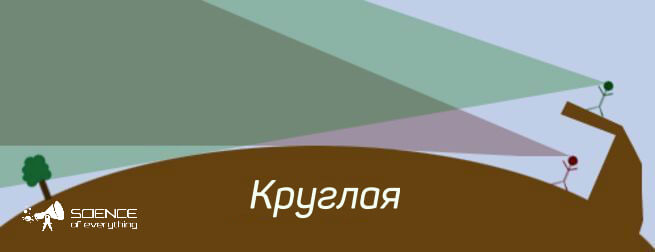
Horizon on a round Earth
How far can you see from above? On a round Earth, elevation matters a lot.
Moriel Schottlender
6. Get on a Plane
If you’ve ever traveled across the country or flown to other countries, you might have noticed two interesting facts about the Earth while on board:
- Planes can fly in a relatively straight line for a very long time without falling off any edges.
- They can also circle the Earth without stopping.
If you look out the window on a transatlantic flight, you’ll often be able to see the curvature of the Earth on the horizon. The view will be stunning. From aboard the new Virgin Galactic jet, the horizon would appear completely curved, as it would fly higher than conventional aircraft.
7. Look at Other Planets
Earth is different from other planets, that’s true. After all, it harbors life, and we haven’t yet found any other planets with life.
However, there are certain characteristics that all planets share, and it’s logical to assume that if all planets behave in a certain way or exhibit certain characteristics—especially if those planets are in different locations or were created under different circumstances—our planet would share those same traits.
In other words: if so many planets, created in different locations and under different circumstances, exhibit the same properties, it’s likely that our own planet shares those properties.
 Solar System Planet – Mars / NASA visualization
All our observations show that the other planets are spherical (and since we already know how they are formed, it’s also obvious why they take this shape). Unless we have compelling reasons to think otherwise (and we don’t), our planet is exactly the same.
In 1610, Galileo Galilei observed the moons of Jupiter. He described them as small planets orbiting a larger one—a description that was very difficult for the church to accept, as it challenged the geocentric model, where everything revolved around Earth. This observation also showed that the planets (Jupiter, Neptune, and later Venus) are spherical, and all orbit the Sun.
8. The Existence of Time Zones
The time in New York City, at the time of writing, is 12:00 PM. The sun is in the middle of the sky (though difficult to see through the clouds). In Beijing, at 12:00 PM, it’s midnight, and the sun is nowhere to be found. In Adelaide, Australia, it’s 1:30 AM. More than 13 hours ahead compared to New York City. Sunset has long since passed there—so much so that the sun will soon rise again and a new day will begin.

Time Zones
We have time zones because when the sun illuminates one side of the spherical Earth, the other side is in darkness.
Moriel Schottlender
Another point about time zones, the sun, and the Earth: if the sun were a «spotlight» (aimed so that the light would only shine in one specific place), and the world were flat, we would see the sun even if it weren’t shining directly over our location. Similarly, you can see The light that shines on the stage in the theater, even though you, the audience, are sitting in the dark. The only way to create two radically different time zones, where one part of the day is dark, while the other is light, is to live on a spherical planet.

The «If the Sun Were a Spotlight» Theory
The visibility of a spotlight in a darkened theater should trample the «Sun as «Spotlight.»
Moriel Schottlender
9. Gravity
Here’s an interesting fact about mass: it attracts other objects. The force of attraction (gravity) between two objects depends on their mass and the distance between them. between them. Simply put, gravity will pull objects toward the center of mass. To find the center of mass, the object must be examined.
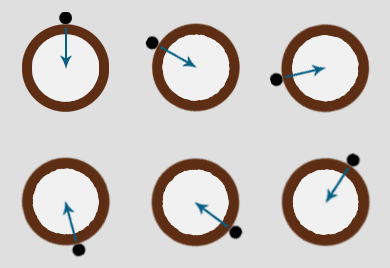
Center of Mass of a Sphere
On a spherical surface, gravity will pull you toward the center of mass of the sphere: straight down.
Moriel Schottlender
Consider a sphere. Since a sphere has a consistent shape, no matter where you stand on it, you have exactly the same amount of that sphere beneath your feet. (Imagine an ant walking on a crystal ball. From the insect’s perspective, the only sign of motion would be the ant’s legs moving—the shape of the surface wouldn’t change at all.) The center of mass of a sphere is at the very center of the sphere, meaning that gravity will pull anything on the surface of the sphere directly toward the center of mass. And this will occur regardless of where the object is located on the surface.
Consider a flat object. The center of mass of a flat object is also at the center, so gravity will pull anything on its surface toward the middle. This means that if you stand on the edge of this flat object, gravity will pull you sideways toward the middle, rather than straight down as on Earth.
We’re pretty sure that even for Australians, an apple falls down, not sideways.
10. Images from Space
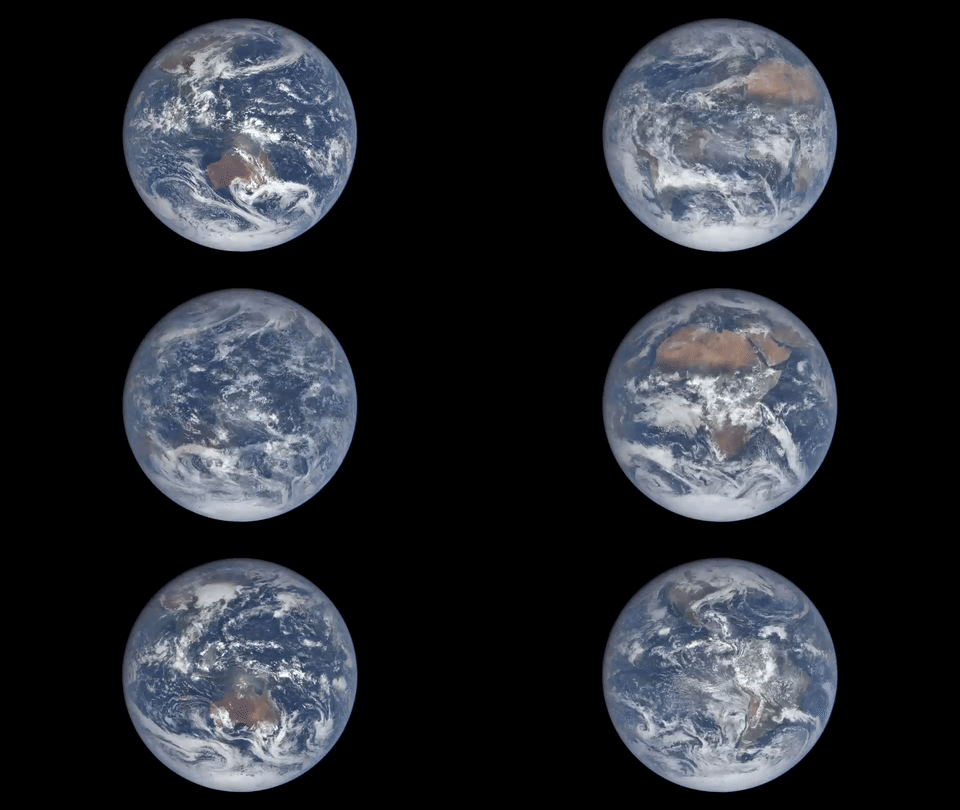
Over the past 60 years of space exploration, we’ve launched satellites, probes, and humans into space. Some have returned, some are still traversing the solar system (and even beyond), and many are transmitting amazing images back to Earth. In all of these photographs, the Earth is spherical. The Earth’s curvature is also visible in many photographs taken by astronauts aboard the International Space Station. Here’s a recent example from Scott Kelly’s Instagram account, taken from the ISS:
«A picture is worth a thousand explanations» – Moriel Schottlender, software engineer at the Wikimedia Foundation.
We hope you are now 100% certain that our Earth is round (close to an oblate ellipsoid). If you still have friends or acquaintances who doubt it, open their eyes and share this article. Don’t deprive them of the chance to enjoy all the privileges of the 21st century!

 Subscribe to the newsletter
Сообщить об опечатке
Текст, который будет отправлен нашим редакторам: