

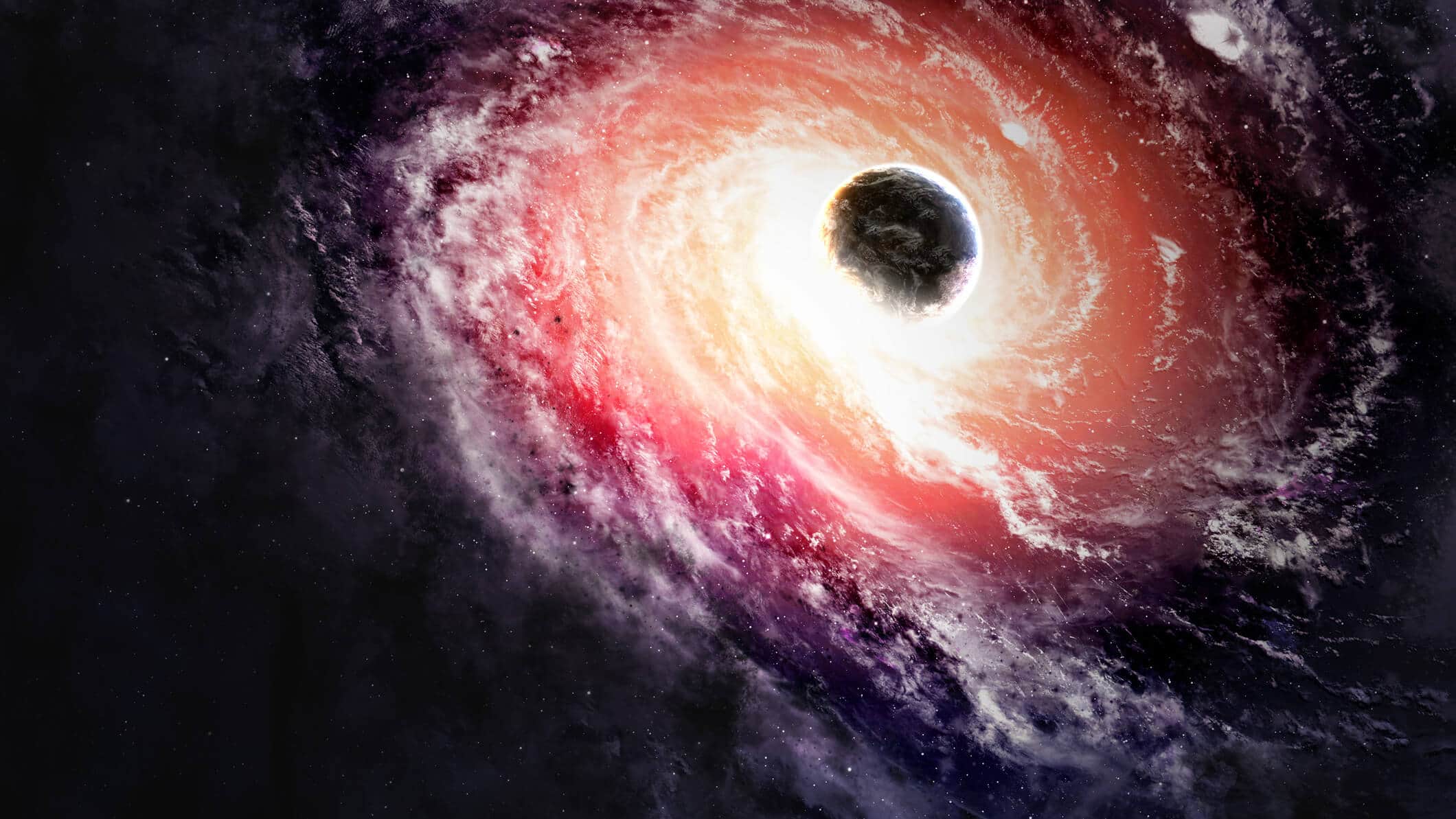
Are black holes truly black? A new laboratory experiment suggests the answer is no.
Using a black hole simulator made from sound waves, scientists observed a phenomenon known as Hawking radiation: a faint burst of energy that, in theory, is created just at the edge of a black hole’s event horizon (the limit beyond which even light cannot escape).
If Hawking radiation comes from real black holes, not just lab simulations, it means such objects are not completely black. This fact could help scientists resolve the black hole paradox and perhaps shed light on one of the most significant problems in modern physics.
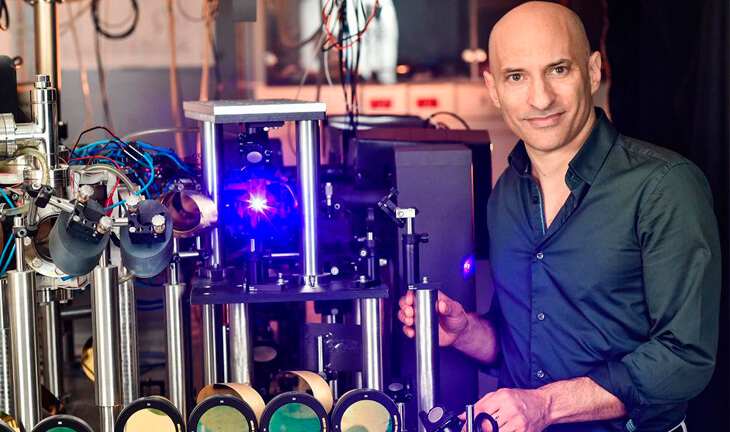
Jeff Steinhauer, an experimental physicist at the Technion (Israel Institute of Technology) and the lead author of this new study, shared his thoughts with readers.
According to Steinhauer, early calculations by cosmologist Stephen Hawking (who created the theory that bears his name) united the theory of quantum physics and the theory of gravity. The current experiment has put these calculations to the test and provided compelling evidence that they are correct.
A black hole is a testing ground for the laws of physics, says Steinhauer.
Swimming Against the Tide
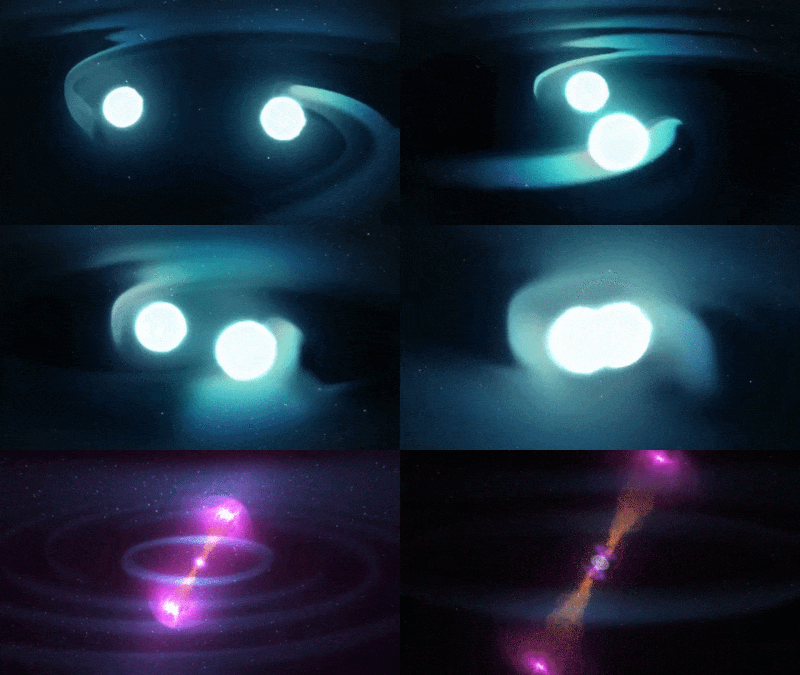
There’s a complex concept in physics that states that pairs of particles are constantly being created and immediately annihilated throughout space. One particle is ordinary matter, and the other is its opposite, or antiparticle. When they are created, they collide and instantly annihilate each other (annihilate). These are so-called virtual particles. When this happens close to the edge of a black hole (the event horizon), particles can escape annihilation—the particle closest to the black hole falls in, while the other is ejected into space.
However, observing such objects remains very difficult, since Hawking radiation around a black hole (if it exists) is so weak that it may not be visible, plus most black holes are located very far from Earth. In addition to the distance, Hawking radiation could very well be interrupted by radiation from other sources, Steinhauer says.
All of this combined makes detecting radiation around a black hole nearly impossible, he said.
The same problem applies to laboratory observations, where any heat can create background radiation that closely resembles the Hawking radiation produced by the simulator. To address this issue, Steinhauer’s experiment achieved temperatures less than one millionth of a degree above absolute zero.
In the black hole analog, a series of laser-cooled rubidium atoms creates a form of matter known as a Bose-Einstein condensate. Cooled gas flows faster than the speed of sound in one direction, so a sound wave, trying to swim against the current, becomes trapped. This can be compared to a swimmer trying to swim against a strong current and being stuck, unable to overcome it.
Attempts to swim upstream are analogous to light trying to escape a black hole. Sound waves «try» to move forward to avoid falling in. If two virtual particles are created near the edge of the event horizon, one particle can be absorbed by the black hole (due to the fast flow), while the other is given the opportunity to «escape,» avoiding annihilation. These «escape» particles are called Hawking radiation.
A similar method was proposed in 1981, and since then, scientists have been trying to simulate Hawking radiation in their laboratories. This new experiment has taken a more wait-and-see approach, watching for a particle-antiparticle pair to emerge without external stimulation, more like what’s happening in the depths of space.
As Hawking predicted, the black hole simulator spits out the predicted particle, which is a direct signature of Hawking radiation.
What I saw suggests «That a black hole mimics something similar,» Steinhauer said.
The new finding also has major implications for physics, he said. One of the biggest mysteries in physics is why Einstein’s theory of gravity (which describes large-scale interactions in the universe) seems incompatible with quantum mechanics (which describes interactions at the atomic level).
«Unifying gravity with quantum physics is one of the main goals of any physicist today,» Steinhauer said. «Hawking took the first steps toward this.»
A black hole simulation tested Hawking’s equations.
«His calculations predicted some kind of radiation, light, from the black hole,» says Steinhauer. «It turns out his calculations were correct.»
The paradox cannot be resolved?
According to Einstein’s theory of relativity, everything that crosses the event horizon of a black hole is absorbed, including information. As escaping particles steal energy from the black hole, a massive object can shrink over time and eventually evaporate into nothingness. Of course, this assumes that the black hole stops absorbing nearby material altogether and, therefore, does not «gain» new weight. Theoretically, a black hole could collapse into nothingness, taking with it the information about the particles it absorbed.
The information vanishes without a trace, he said. It falls into the black hole and evaporates along with it.
Since quantum mechanics suggests that information cannot be completely lost, such a statement raises a paradox.
According to Hawking’s calculations, the surviving particles (the escaped ones) contain no useful information about how the black hole formed or what particles it absorbed, leading to the conclusion that the data disappeared into the black hole itself along with the absorbed particle pairs.
Steinhauer’s black hole showed that high-energy particles remain entangled even after being absorbed by the event horizon. Entangled particles can instantly exchange information even when separated by vast distances, a phenomenon sometimes called «spooky action at a distance.»
Some solutions to this paradox likely rely on entanglement, says Steinhauer.
Several scientists unaffiliated with the study were interviewed after the experiment. Their opinion is that although the experiment measured Hawking radiation, this does not necessarily prove its existence around a black hole in space.
The study was published online in the journal Nature Physics.

 Subscribe to the newsletter


Сообщить об опечатке
Текст, который будет отправлен нашим редакторам: