

In the middle of a clean room at NASA’s Kennedy Space Center, a small telescope sits for a final series of pre-launch checks.The extreme caution is due to the fact that the observatory’s four cameras will fly without protective covers. One of several was created to facilitate the use of the Transiting Exoplanet Survey Satellite (TESS). Its goal will be to estimate the mass, surface area, and potential of planets like ours as part of the first observatory conducted in outer space.
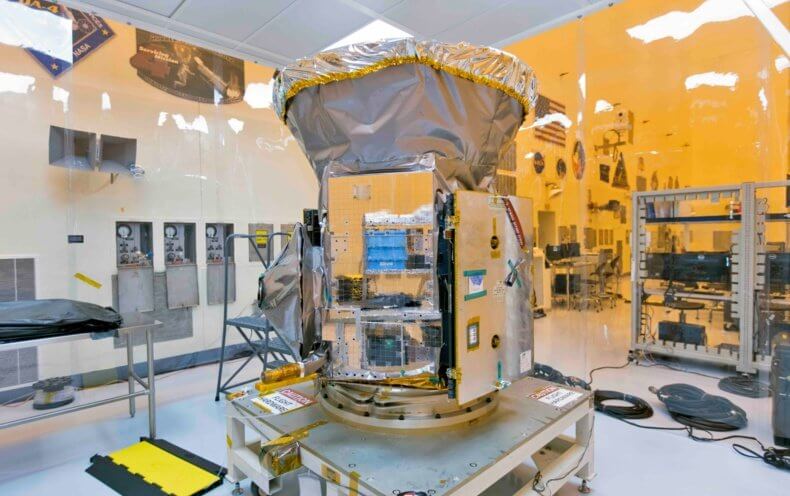
Photo source: NASA.
The idea for TESS was conceived even before NASA’s Kepler satellite, launched in 2009, demonstrated the viability of space-based exoplanet surveys. Both telescopes use the «transit» method to search for planets, which involves finding the silhouettes of mysterious wanderers against the bright light of their parent stars relative to the telescopes’ lines of sight. Kepler didn’t use transit as its primary search technique; it also revealed galaxies with planets two to four times larger than Earth.
During its initial mission, Kepler discovered stars more than 1,000 light-years away in the constellations Cygnus, Lyra, and Draco. To date, scientists have detected 2,341 exoplanets with Kepler’s eyes out of 170,000 objects in the satellite’s discovery pool. Another 4,396 potential planets are under consideration, but many will never be confirmed because their stellar hosts are too dim to be easily observed by ground-based telescopes for the necessary follow-up studies.
The TESS team is taking the opposite approach, starting with ground-based observations and preliminary candidate confirmations from Earth, then providing specific targets for the orbiting telescope. They have selected approximately 200,000 stars to study during TESS’s two-year primary mission. Each of these target stars has already been studied in detail by the European Space Agency’s Gaia telescope, which is cataloging stellar positions and distances.
Most of TESS’s targets are within 300 light-years of Earth, significantly closer and hundreds of times brighter than most stars studied by Kepler. «With TESS, we’ll be able to make ground-based observations of all of them. It’s just a matter of priorities, not capabilities,» says project scientist Stephen Rinehart of NASA’s Goddard Space Flight Center.
The transit technique, pioneered by Kepler and planned for TESS, reveals the size of a planet relative to its host star. If scientists can observe multiple transiting objects, they can also determine how far the planets orbit the star—information that can then be used to estimate its temperature and whether a potential exoplanet could support liquid water on its surface, a key factor for life.
However, estimating a planet’s mass, which is essential for determining whether the planet is composed of metal and rock, or ice and gas, requires ground-based telescopes. As it turns out, it often only takes a relatively modest observatory to detect the subtle wobbles in a star’s orbit caused by the small but regular gravity of its orbiting planetary brood. The TESS project requires dozens of astronomers and the reservation of several ground-based telescopes.
THE HUNT HAS BEGUN
The hunt for planets like our own begins around the time of TESS’s launch, scheduled for mid-April. At that time, the telescope is scheduled to arrive in an unusual orbit that loops high around Earth. It will travel about 67,300 miles (108,309 km) before approaching the Moon’s orbit at nearly 234,000 miles (376,586,496 km). When TESS is at the highest point of its orbit relative to Earth, the Moon will be 90 degrees to the left or right, acting as orbital ballast that will support the telescope for decades without the use of thrusters.
This eccentric orbit allows TESS to spend most of its time in deep, dark space, with minimal interference from sunlight and reflections of light from Earth and the Moon. TESS will orbit the planet every 13.7 days, rotating exactly twice as fast as the Moon. When it reaches its closest approach to Earth, it will pause observation for 10 hours to transmit stored scientific data to one of three NASA ground stations. These transmissions will occur at high-speed Ka-band frequencies, which will be used for the first time on a network, paving the way for future space missions, including the James Webb Space Telescope.
TESS data will not only include brightness measurements of the target star every two minutes, but also a full-sky image every half hour, capturing more than 20 million stars and 10 million galaxies. “This is a treasure trove of data that will be mined for years,” says NASA astronaut Patricia Boyd, who leads Goddard’s TESS Guest Investigator Program.
The telescope is equipped with four cameras positioned to cover a wedge of sky 24 degrees across and 96 degrees long, equivalent to about 10,000 full moons. By shifting its field of view every two orbits, TESS will cover the entire southern hemisphere of the sky during its first year of operation, then flip to study the northern hemisphere in the subsequent second year. Overall, TESS will cover 90 percent of the sky, an area 400 times larger than Kepler’s observations.
Of key interest are the stars around [the sun]. href=»https://books.google.com.ua/books?id=Agp8WTnkLhgC&pg=PA45&lpg=PA45&dq=%D0%B7%D0%B2%D0%B5%D0%B7%D0%B4%D1%8B+%D0%B2%D0%BE%D0%BA%D1%80%D1 %83%D0%B3+%D0%BF%D0%BE%D0%BB%D1%8E%D1%81%D0%BE%D0%B2+%D1%8D%D0%BA%D0%BB%D0%B 8%D0%BF%D1%82%D0%B8%D0%BA%D0%B8&source=bl&ots=gxI7sfaF-m&sig=lpxq 5swFpvuE5j-nR_Gc1tAgtO0&hl=ru&sa=X&ved=0ahUKEwjwv_uSzefZAhUKSJoK HcKUBbsQ6AEIUjAI#v=onepage&q=%D0%B7%D0%B2%D0%B5%D0%B7%D0%B4%D1%8B%20%D0% ecliptic polesthat will be included in every piece of sky surveyed by TESS. These are the stars directly above and below the plane of the ecliptic, in which the planets move around the Sun. Worlds in these regions will be the primary targets for subsequent exploration by the James Webb Space Telescope, which, among other tasks, will attempt to determine the atmospheric chemistry of some exoplanets. Webb is scheduled to launch in 2019. «In this role, TESS serves as a search engine for Webb. We’re looking for a special star orbiting a potential exoplanet,» says TESS project manager George Ricker of the Massachusetts Institute of Technology.
Ricker adds that achieving the goal of measuring the masses of 50 minor planets «wouldn’t be difficult.» Moreover, simulations predict that more than 500 minor planets, not just 50, are expected to be confirmed by the end of the initial three-year mission, he says. Ultimately, TESS could contribute up to 20,000 new planets to the exoplanet catalog, most of which will orbit red dwarfs, which are 1/4 to 1/2 the diameter of the Sun and much darker and cooler. M-class dwarfs make up about 70% of the Milky Way’s stars and are TESS’s primary targets.
“For me, the most exciting thing about any new mission is what you don’t expect,” says Rinehart, the project scientist. “I really hope that somewhere out there we’ll find something strange and unimaginable, something we can’t explain. I think that’s what’s out there, but I have no idea what it will be.”
Original article: Scientific American

 Subscribe to the newsletter


Сообщить об опечатке
Текст, который будет отправлен нашим редакторам: