

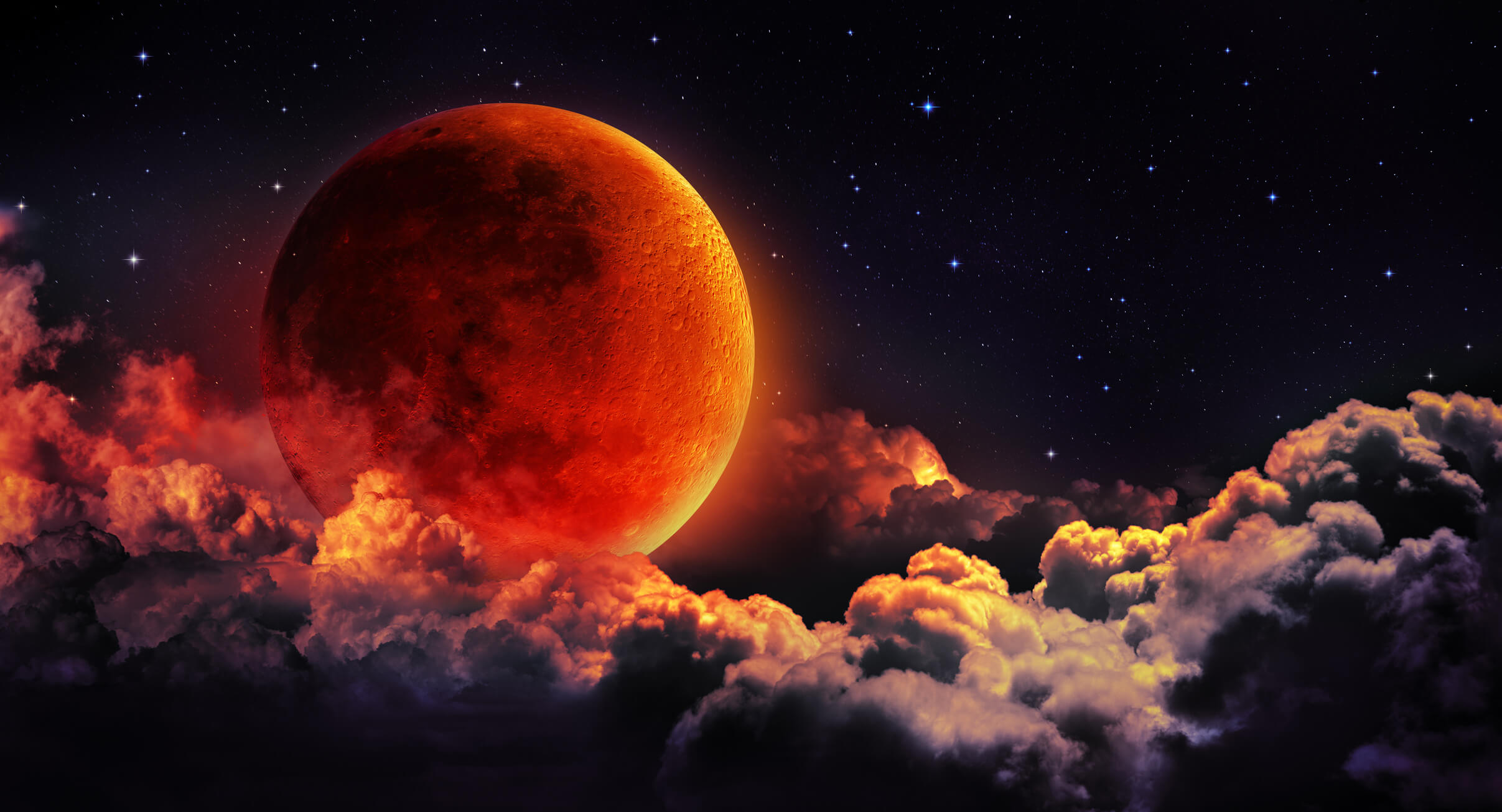
When a huge crimson orb rises into the sky and transforms into an ordinary, pale moon, it’s enough to make some people faint. And, with good reason, it’s fair to say that the fiery glow is the most dramatic and recognizable of the three eclipses (total, partial, and penumbral).
Furthermore, the most perfect total lunar eclipse occurs under the following condition: when the Sun, Earth, and Moon are perfectly aligned.
When the Moon creeps into the central part of the Earth’s shadow and becomes completely shrouded in darkness, why doesn’t it «turn off» in the sky? Why is the Moon instead engulfed in a light orange to blood red glow?
Here’s why: Imagine yourself standing on the Moon (with lots of dust and craters in front of you), looking down at Earth during this magnificent event. When the Earth is directly opposite the Sun, it blocks the Sun’s rays from illuminating the Moon, and as a result, you see a fiery rim encircling the dark side of the Earth.
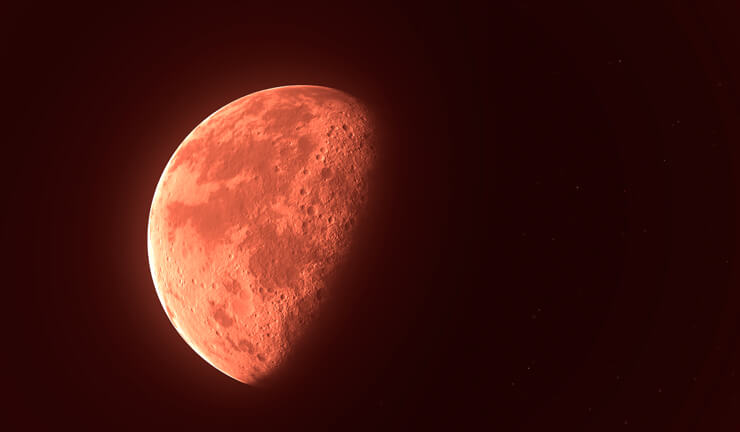
Remember, we’re still standing on the Moon, with craters and lunar valleys in front of us, and most significantly, the Earth appears larger to us than the Sun. According to NASA, «The dark side of the Earth, away from the Sun, is ringed with a red glow during each sunrise and sunset.» The light from our star bends around the edge of the Earth. This light reflects onto the Moon. But when it passes through our atmosphere, it filters out the short-wavelength blue light, leaving red and orange rays bathing the lunar surface. And voila, a red Moon.
The Moon’s various hues will change during the different stages of a total lunar eclipse, ranging from an initial grayish hue to orange and amber. Atmospheric conditions can also affect the brightness of the color. For example, extra particles in Earth’s atmosphere, such as ash from a large fire or a volcanic eruption, may be responsible for the dark red hues on the Moon, according to NASA.
The Moon is not always completely hidden in Earth’s shadow. During a partial lunar eclipse, the Sun, Earth, and Moon are not aligned, and our planet’s shadow absorbs only part of the Moon.An inexperienced skywatcher might not even notice the third type of lunar eclipse, a penumbral eclipse, in which the Moon is in the Earth’s penumbra, or faint outer shadow.
The next total lunar eclipse will occur on July 27, 2018, and is expected to be visible from South America, Europe, Africa, Asia, and Australia.
As for other types of lunar eclipses, the next penumbral eclipse will be will occur on January 10, 2020. The next partial eclipse is expected to be visible from South America, Europe, Africa, Asia, and Australia, and will occur on July 16, 2019.
Original article on Live Science

 Subscribe to the newsletter

комментарии