

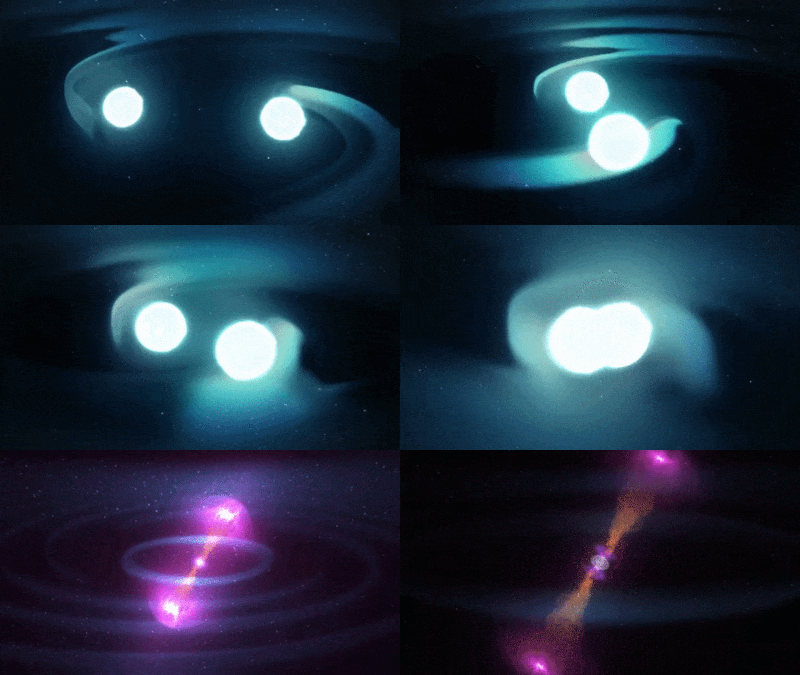
First came the gravitational waves. Then came the gamma-ray burst. As night fell in Chile, a small telescope picked up signals in the dark skies: for the first time in history, the merger of two neutron stars was detected using gravitational waves.
A few hours after the first signal was detected by the LIGO Gravitational-Wave Observatory detector, on August 17, about 70 telescopes and observatories around the planet turned their gaze to the same point in the night sky – the outskirts of the galaxy NGC 4993 in the constellation Hydra.
LIGO spokesman David Shoemaker notes that these are the first gravitational waves not from a black hole, but from other objects; the first evidence that neutron star mergers can produce gamma-ray bursts; and the first observation of heavy elements being formed; the first measurement of the expansion of the Universe using gravitational waves.
 Merge of two neutron stars
1M2H/UC Santa Cruz and Carnegie Observatories/Ryan Foley
New detector Virgo in Italy helped pinpoint the location of the event and outline the region, which was then studied by optical telescopes.
The merger was observed in both the electromagnetic spectrum, radio, and gamma rays. This is the first event in history to be observed in both gravitational waves and light.
Gravitational waves give us insight into the internal mechanisms of the collision, while images in different wavelengths of light, including those from the Hubble Space Telescope, reveal the visual component—the resulting cloud of hot plasma and gas.
The signals from the two neutron stars turned out to be much closer than the first gravitational wave signals from black holes—130 million light years versus a billion or more.
Also, using gravitational waves from the merger of these two cosmic giants, LIGO confirmed the expansion rate of the Universe, which is approximately 72 kilometers per second per megaparsec.
The event confirmed the phenomenon of a «kilonova»—a powerful flash that occurs when two massive objects merge.
Scientists suspect that neutron star mergers are what produce heavy elements such as cesium, gold, platinum, lead, uranium, and others.
«A kilonova can last a very long time—from weeks to months,» says Shane Larson of Northwestern University in Illinois.
And as LIGO increases its sensitivity over the next few years, it will be able to detect up to one neutron star merger every week, not to mention detecting even more exotic signals from objects like supernovae or, who knows, even cosmic strings.
This is the first time in history that scientists have been able to see a phenomenon in the light spectrum and listen to its vibrations in spacetime simultaneously.
This is a new era of observing the Universe with all our senses at once.
Read also:

 Subscribe to the newsletter

Сообщить об опечатке
Текст, который будет отправлен нашим редакторам: