

While much of space remains mysterious and unexplored, we do know that it’s vast. Incredibly vast. To quantify the vastness of space, there’s a unit—the light-year.
What does this mean?
While «light-year» sounds like a unit of time, it’s actually a measure of distance. A light-year is the length of space light travels in a year.
Specifically, the International Astronomical Union defines a light-year as the distance light travels in 365.25 days.
Similarly, you could describe a car’s speed as 60 mph (96.56 km/h)—the distance a car travels on the highway in an hour. In fact, we often talk to people about distance in terms of time—»I’ll be gone for 10 minutes,» for example. The term «light-year» was invented because, simply put, the equivalent distances in miles, meters, or kilometers were enormous.

But just how big? Light travels 299,792.5 kilometers per second. The distance to the nearest star is 4.3 light-years, or 40.7 trillion km. You can imagine how inconvenient it is to use standard units of measurement.
The first mention of light-years dates back to 1838, when the German scientist Friedrich Bessel measured the distance to a star called 61 Cygni and calculated it to be 660,000 times the Earth’s orbital radii. He noted that it would take light about 10 years to get there, but he disliked the term «light-year.» (One reason for this was that at the time it was unclear whether the speed of light was a fundamental constant of nature.) In 1851, the term first appeared in Germany, in the astronomical compendium Lichtjare. Later, astronomers adopted the «light-year» as a unit of measurement, which is now very popular in scientific literature.
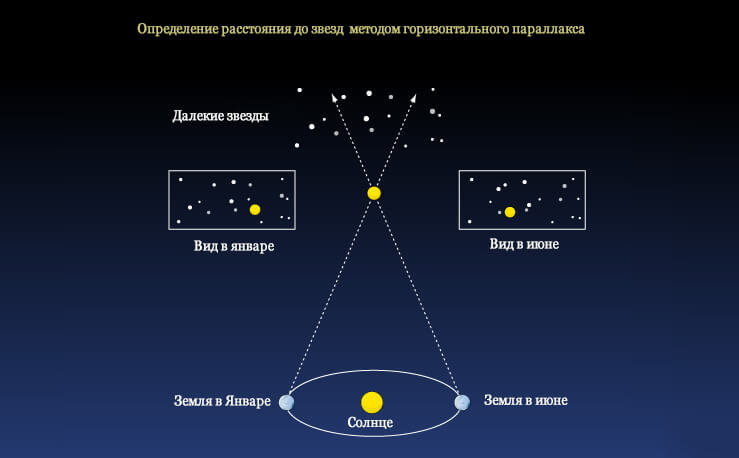
The light-year competes with the parsec (3.26 light-years), whose name is derived from the words parallax and secunda. A parallax second is the number of arcseconds (1/3600th of a degree) of shift in the apparent position of a star when measuring its distance. That is, a parsec is equal to the distance to an object, the annual trigonometric parallax (the change in a star’s coordinates caused by the observer’s position due to the Earth’s revolution around the Sun), which is equal to one arcsecond. British astrophysicist Arthur Eddington, a prominent scientist in the early 20th century, preferred the parsec, as using the term light-year was «inconvenient.» However, Eddington lost this battle.
Light-years can be divided into light-days, hours, or even light-seconds, although these units are less commonly used. The Sun is 8 light-minutes away, meaning it takes light 8 minutes to reach Earth.

All of this depends on knowledge of the speed of light, which is very difficult to measure because light travels quite quickly. Galileo made his first attempt in 1638, describing an experiment in which one person covers a lantern while another on a tower some distance away attempts to time the light’s travel. The experiment failed, and Galileo attributed this to the speed of light being so great that neither human reflexes nor a stopwatch could detect it (he proposed an estimate of at least 10 times the speed of sound, but this was only a guess).
Danish astronomer Ole Rømer was able to make an estimate in 1676 using the timing of eclipses of Jupiter’s moon Io. Later, in 1729, James Bradley used a phenomenon called stellar aberration, in which the apparent positions of stars in the sky appear to change slightly depending on the Earth’s motion, to arrive at a closer estimate of the speed of light. Scientists continued to refine these estimates, and in the 1860s, Scottish physicist James Clerk Maxwell demonstrated that electromagnetic waves travel at a specific speed in a vacuum. This speed is constant, and at the time, most physicists thought of light as a wave.
We now know that this is not the case: light can be both a wave and a particle.
Finally, in 1905, Albert Einstein’s special theory of relativity settled the matter, stating that light always travels at the same speed. speed, regardless of the observer’s location. This was a major step, because suddenly the speed of light became one of the constants of the Universe—and thus became more useful and convenient for measuring distances.
Original article in Live Science magazine.

 Subscribe to the newsletter





Сообщить об опечатке
Текст, который будет отправлен нашим редакторам: