

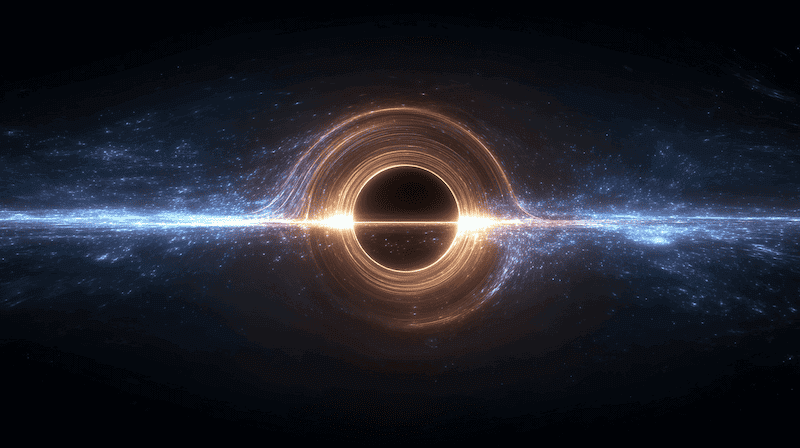
Black holes are fascinating objects in space that have captured the imagination of scientists and science fiction enthusiasts alike. But what exactly are they, and how do they come into existence? Let’s dive into the mysterious world of black holes and shed some light on these cosmic wonders.
Black holes are regions in space where gravity is so strong that nothing, not even light, can escape its pull. They are formed when massive stars die and undergo a supernova explosion, leaving behind a dense core known as a stellar remnant. If this core is more massive than about three times the mass of the Sun, it collapses under its own gravity and forms a black hole.
- Stellar Black Holes: These are the most common type of black holes and are formed from the remnants of massive stars. They can be several times larger than our Sun but are incredibly compact.
- Intermediate Black Holes: These are smaller than supermassive black holes but larger than stellar black holes. Their origins are still not fully understood, and they may form from the merger of smaller black holes or the collapse of massive stars.
- Supermassive Black Holes: These are the largest type of black holes, found at the centers of galaxies. They can be millions or even billions of times more massive than the Sun and play a crucial role in the evolution of galaxies.
Black holes have several key properties, including their mass, size, event horizon, and singularity. The event horizon is the boundary around a black hole beyond which nothing can escape, while the singularity is the point of infinite density at the center of a black hole.
In the next sections, we will explore the different types of black holes in more detail, discuss their characteristics, and delve into the exciting mysteries and paradoxes that surround them. So buckle up, and get ready for a journey into the heart of darkness in the cosmos.
Types of Black Holes: Stellar, Intermediate, and Supermassive
Black holes come in different sizes, each with its own unique characteristics and formation processes. Let’s take a closer look at the three main types of black holes:
- Stellar Black Holes: These are the smallest type of black holes, typically formed when a massive star collapses in on itself during a supernova explosion. The intense gravitational pull of the remaining core causes it to collapse into a singularity, creating a black hole. Stellar black holes can have a mass up to 20 times that of our sun.
- Intermediate Black Holes: These black holes fall between the stellar and supermassive categories in terms of size and mass. They are thought to form when multiple smaller black holes merge together or through the direct collapse of massive stars. Intermediate black holes have masses ranging from 100 to 100,000 times that of the sun.
- Supermassive Black Holes: At the other end of the spectrum are supermassive black holes, which inhabit the centers of galaxies. These giants can have masses millions or even billions of times greater than the sun. The exact mechanism behind the formation of supermassive black holes is still a topic of ongoing research, but they play a crucial role in the evolution of galaxies.
Each type of black hole presents a different challenge for astronomers to study, but they all offer valuable insights into the nature of space and time.
Properties of Black Holes: Mass, size, event horizon, and singularity
Black holes are some of the most mysterious and fascinating objects in the universe. They come in various sizes and have unique properties that make them stand out from everything else we know.
- Mass: The mass of a black hole determines how strong its gravitational pull is. The more massive a black hole is, the stronger its gravity becomes. Black holes can have masses that range from a few times that of our sun to billions of times the mass of the sun.
- Size: Black holes are incredibly dense objects, which means they have a very small volume compared to their mass. The size of a black hole is usually described by its event horizon, which is the point beyond which nothing, not even light, can escape its gravitational pull.
- Event Horizon: The event horizon of a black hole is like an invisible boundary that marks the point of no return. Once an object crosses the event horizon, it is trapped inside the black hole and cannot escape. This makes the event horizon a key feature of black holes.
- Singularity: At the center of a black hole lies a singularity, a point where the mass of the black hole is concentrated into a single point of infinite density. The laws of physics as we know them break down at the singularity, which makes it a point of great interest and mystery for scientists.
Understanding the properties of black holes helps us unravel their secrets and learn more about the nature of space and time. Mass, size, event horizon, and singularity are all essential components that define how black holes behave and interact with the surrounding universe.
Understanding the Event Horizon: The point of no return around a black hole
Imagine a black hole as a cosmic vacuum cleaner, sucking in everything that comes too close to its powerful gravitational pull. At the heart of every black hole lies the event horizon, a boundary beyond which escape is impossible.
- What is the event horizon?
- How does it work?
- Why can’t anything escape?
- Are there different types of event horizons?
The event horizon is like a force field surrounding a black hole, marking the point of no return. Once an object crosses this boundary, even light itself cannot escape, giving black holes their eerie darkness.
As an object nears the event horizon, the gravitational pull becomes stronger, stretching and distorting the object until it is torn apart in a process called spaghettification. This phenomenon demonstrates the sheer power of a black hole’s gravity.
The event horizon is where the gravitational pull of the black hole becomes so intense that the escape velocity surpasses the speed of light. Since nothing can move faster than light, once inside the event horizon, there is no way out.
Yes, depending on the size and properties of the black hole, there are different variations of event horizons. For example, a supermassive black hole will have a much larger event horizon compared to a stellar black hole.
Understanding the event horizon is crucial in comprehending the true nature of black holes. It serves as a physical boundary that separates the known universe from the unknown depths of these mysterious objects. As we continue to delve deeper into the secrets of black holes, the event horizon remains a pivotal concept in our quest for knowledge about the universe and its darkest phenomena.
The Formation and Evolution of Stellar Black Holes
Stars are born from clouds of gas and dust, and throughout their lives, they undergo vast changes. When a massive star ends its life, it can collapse under its own gravity, forming a stellar black hole.
As a star exhausts its nuclear fuel, it expands into a red giant before shedding its outer layers in a spectacular supernova explosion. What remains collapses into a small, incredibly dense object known as a neutron star. However, if the star is even more massive, it may continue to collapse beyond the neutron star stage, forming a stellar black hole.
Stellar black holes are characterized by their relatively small size compared to supermassive black holes, with masses typically ranging from about three to twenty times that of our Sun. Despite their smaller size, they possess immense gravitational pull due to their high density.
Once a stellar black hole forms, it continues to interact with its surroundings, attracting nearby matter with its strong gravitational force. When enough material falls into a black hole’s event horizon, it forms an accretion disk and emits powerful X-rays and other forms of radiation as it spirals inward.
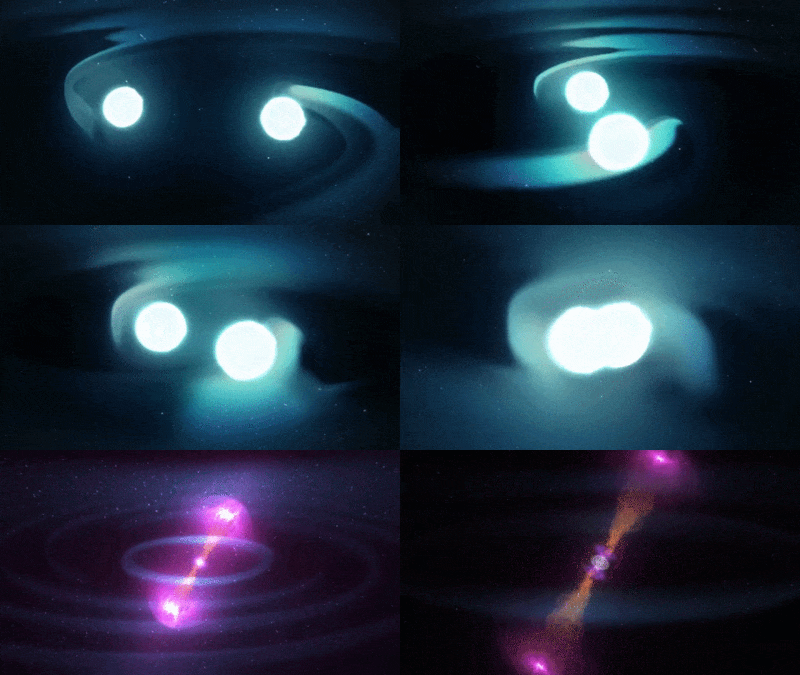
Over time, stellar black holes can merge with other black holes or cosmic objects, increasing their mass and potentially transforming them into intermediate black holes. These merging events release gravitational waves, which are ripples in spacetime predicted by Einstein’s general theory of relativity and recently detected by advanced observatories on Earth.
In understanding the formation and evolution of stellar black holes, scientists gain insights into the life cycles of stars and the fundamental processes that govern the universe. By studying these cosmic phenomena, we unravel the mysteries of the cosmos and expand our knowledge of the interconnectedness of all celestial bodies in the vast expanse of space.
Characteristics of Intermediate Black Holes:
Intermediate black holes fall in between the two extremes of stellar black holes and supermassive black holes. They are not as tiny as stellar black holes, which form when massive stars explode in a supernova, nor are they as vast as supermassive black holes found at the centers of galaxies.
These mid-sized black holes have masses ranging from hundreds to thousands of times the mass of our Sun. While still much smaller than supermassive black holes, intermediate black holes are larger than their stellar counterparts.
One interesting characteristic of intermediate black holes is their rarity. They are not as commonly observed as stellar black holes or supermassive black holes. This has made studying them and understanding their properties more challenging for scientists.
- Intermediate black holes have an event horizon, just like all black holes, but the size of this boundary can vary based on their mass.
- They possess gravitational pulls strong enough to trap light and matter, but their influence might not extend as far as supermassive black holes do.
- Scientists have discovered some instances of intermediate black holes within star clusters or interacting galaxies, hinting at how they may form under specific conditions.
Due to their unique properties and placement in the size spectrum of black holes, intermediate black holes serve as valuable intermediaries in our understanding of these mysterious cosmic objects. Studying them can provide insights into how black holes evolve and interact with their surroundings.
As astronomers continue to discover and study more examples of intermediate black holes, they hope to uncover more clues about the formation and behavior of these intriguing cosmic phenomena. The study of intermediate black holes remains an exciting area of research within the field of astrophysics.
Supermassive Black Holes in the Centers of Galaxies: Their role in galaxy formation and evolution
When we look into the center of a galaxy, we often find a supermassive black hole lurking there. These incredibly massive entities play a crucial role in shaping the galaxy’s structure and influencing its evolution over time. But how exactly do they do this?
- Matter Devourers: Supermassive black holes have an immense gravitational pull that can consume vast amounts of matter and energy. As they feed on gas, dust, and even stars, they release immense amounts of radiation and jets of particles that can influence the surrounding environment.
- Galaxy Growth: The presence of a supermassive black hole can affect the growth of the galaxy it resides in. The energy released during feeding periods can trigger the formation of new stars or inhibit star formation processes. This delicate balance shapes the galaxy’s overall structure and composition.
- Galactic Dynamics: Supermassive black holes also have a significant impact on the dynamics of the galaxy they inhabit. Their gravitational influence can affect the motion of stars and other celestial bodies within the galaxy, leading to complex interactions and orbital patterns.
Scientists believe that supermassive black holes may even play a role in triggering galactic mergers and interactions, leading to the creation of new structures and potentially influencing the overall population of galaxies in the universe.
While much about supermassive black holes remains a mystery, their presence at the heart of galaxies is undeniable. As we continue to study these cosmic behemoths, we gain valuable insights into the processes that shape the universe on a grand scale.
Evidence for the Existence of Black Holes: Observational Methods
Even though black holes are invisible and can’t be directly observed, scientists have come up with clever ways to detect their presence based on the effects they have on surrounding matter and light. Here are some of the main techniques used to find and study black holes:
- X-ray Emissions: One of the telltale signs of a black hole is the intense X-ray radiation that is emitted when matter falls towards it and heats up. Telescopes like Chandra and XMM-Newton can detect these X-rays coming from black hole systems.
- Gravitational Lensing: When a black hole passes in front of a star or a distant quasar, its massive gravity can actually bend and distort the light from the background object. This phenomenon, known as gravitational lensing, can help astronomers infer the presence of a black hole.
- Doppler Effect: As matter swirls around a black hole before falling in, it emits light at specific wavelengths. By analyzing this light, scientists can study the velocity and movement of the material to determine if a black hole is present.
- Radio Observations: Some black holes, especially supermassive ones at the centers of galaxies, emit powerful jets of radio waves as matter spirals into them. Radio telescopes like the Very Large Array (VLA) are used to detect and study these emissions.
By combining data from different telescopes and observing different wavelengths of light, astronomers can paint a more complete picture of black holes and their surroundings. These techniques allow us to learn more about the mysterious nature of black holes, despite the fact that we can’t see them directly.
Hawking Radiation and Black Hole Thermodynamics
One of the most famous scientists to study black holes, Stephen Hawking, made incredible contributions to our understanding of these mysterious cosmic entities. One of his groundbreaking theories was on black hole radiation, now known as Hawking radiation.
According to Hawking’s theory, black holes are not completely black, as they were originally thought to be. Instead, they emit a very faint radiation over time due to quantum mechanical effects near the event horizon. This means that black holes can slowly lose mass and eventually evaporate.
Understanding black hole thermodynamics is another fascinating aspect of Hawking’s work. Thermodynamics deals with the relationship between energy, temperature, and entropy in systems. Hawking showed that black holes have a temperature and can therefore be linked to the concept of entropy.
- Temperature: Black holes have a temperature inversely proportional to their mass, meaning smaller black holes are hotter than larger ones. This temperature is incredibly low, making it nearly impossible to detect directly.
- Entropy: Entropy is a measure of disorder or randomness within a system. Black holes have an enormous amount of entropy associated with them, leading to the concept of black hole thermodynamics.
Hawking’s work on black hole radiation and thermodynamics revolutionized our understanding of these enigmatic objects and opened up new avenues for research in theoretical physics.
Black Hole Paradoxes and Solutions: Information paradox and other mysteries surrounding black holes
Black holes are fascinating objects in the universe that have puzzled scientists for many years. One of the most intriguing paradoxes associated with black holes is the information paradox. This paradox arises from the clash between two fundamental theories of physics: general relativity and quantum mechanics.
According to general relativity, when an object falls into a black hole, all information about that object is lost behind the event horizon. This means that the information is seemingly destroyed and cannot be retrieved, leading to a violation of the principle of conservation of information. On the other hand, quantum mechanics dictates that information cannot be destroyed, creating a conundrum.
Scientists have been striving to find a resolution to this paradox, with some proposing that the information of particles falling into a black hole might be encoded on its event horizon, known as the holographic principle. Other theories suggest that the information may be released back into the universe through processes like Hawking radiation.
In addition to the information paradox, there are other mysteries surrounding black holes that continue to baffle researchers. For instance, the nature of the singularity at the center of a black hole is still a point of contention. Singularities are regions of infinite density and spacetime curvature, where the known laws of physics break down. Understanding what happens at the singularity is crucial for unlocking the secrets of black holes.
Another persistent mystery is the concept of black hole jets. These powerful streams of particles are emitted from black holes at near-light speeds, yet the exact mechanism behind their formation remains unclear. Studying these jets could provide valuable insights into the processes occurring within black holes and their surroundings.
Despite these enigmas, researchers remain optimistic about unraveling the mysteries of black holes. Through innovative technologies and collaborations, scientists are pushing the boundaries of our understanding of these enigmatic cosmic phenomena. As we delve deeper into the secrets of black holes, we are not only gaining valuable knowledge about the universe but also challenging our fundamental understanding of physics.
Future of Black Hole Research
As we stand on the frontier of black hole science, exciting new discoveries and potential breakthroughs are on the horizon. Recent advancements in technology and observation methods have allowed researchers to delve deeper into the mysteries of these enigmatic cosmic giants.
One area of growing interest is the study of gravitational waves, ripples in spacetime caused by violent cosmic events such as the collision of black holes. The detection of these gravitational waves has opened up a new window into the universe and provided scientists with valuable insights into the physics of black holes.
Furthermore, advancements in theoretical physics have led to the development of new models and approaches for understanding the behavior of black holes. Scientists are exploring the possibilities of using quantum mechanics to describe the properties of these gravitational behemoths and unraveling the mysteries of black hole thermodynamics.
Another exciting aspect of current research is the exploration of black holes as laboratories for testing fundamental principles of physics. By studying the behavior of matter and energy in the extreme environment around black holes, scientists hope to shed light on some of the most puzzling questions in modern physics.
In addition, the advent of new space telescopes and observatories promises to revolutionize our understanding of black holes. Projects such as the Event Horizon Telescope and the upcoming James Webb Space Telescope will allow researchers to peer deeper into the heart of these cosmic mysteries and capture unprecedented images of black holes in action.
As we look to the future, the field of black hole research is poised for groundbreaking discoveries that will reshape our understanding of the universe. By pushing the boundaries of human knowledge and technology, scientists are unlocking the secrets of black holes and paving the way for a new era of astrophysics.
Conclusion
After diving into the mysterious world of black holes, we have gained a better understanding of these fascinating astronomical phenomena. From their formation to their properties and beyond, black holes continue to capture our curiosity and spark incredible discoveries in the field of astrophysics.
- We learned that black holes are regions in space where gravity is so strong that nothing, not even light, can escape their grasp.
- There are different types of black holes, ranging from stellar black holes, formed from the remnants of massive stars, to supermassive black holes, found at the centers of galaxies.
- Properties such as mass, size, event horizon, and singularity define the characteristics of black holes and set them apart from other celestial objects.
- The event horizon marks the point of no return, beyond which inevitable doom awaits anything that ventures too close to a black hole.
- Understanding the formation and evolution of black holes, including the life cycle of stars leading to stellar black hole creation, sheds light on their importance in the universe.
- Intermediate black holes bridge the gap between stellar and supermassive black holes and play a crucial role in our understanding of these enigmatic entities.
- Supermassive black holes hold an essential place in galaxy formation and evolution, influencing the galaxies we observe in the cosmos.
- Evidence for black holes comes from various observational methods, showcasing the ingenuity and advancements of modern science in exploring the universe.
- Hawking radiation and black hole thermodynamics, based on Stephen Hawking’s groundbreaking theories, provide insights into the complex nature of black holes.
- Black hole paradoxes challenge our conventional understanding of physics, raising thought-provoking questions about the nature of these cosmic phenomena.
- The future of black hole research looks promising, with recent discoveries and potential breakthroughs pointing toward exciting developments in the field of astrophysics.
In conclusion, black holes stand as some of the most mind-boggling entities in the universe, pushing the boundaries of our knowledge and sparking imaginative exploration into the depths of space. Their significance in astrophysics goes far beyond their gravitational pull, offering a window into the mysteries of the cosmos and a glimpse into the wonders that await us beyond the stars.

 Subscribe to the newsletter


Сообщить об опечатке
Текст, который будет отправлен нашим редакторам: