

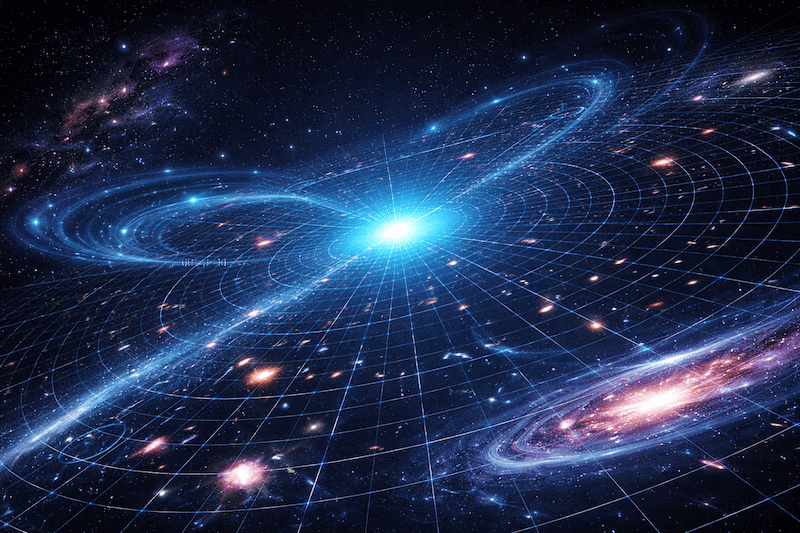
Dark energy is a mysterious force that makes up about 70% of the universe. Unlike matter and radiation, which have been well-studied by scientists, dark energy remains elusive and baffling. It is responsible for the observed accelerated expansion of the universe, a phenomenon that was discovered relatively recently in the history of cosmology.
- What is Dark Energy?
- Why is it called «Dark» Energy?
- Significance of Dark Energy
Dark energy is a form of energy that permeates all of space and exerts a negative pressure that causes the universe to expand at an accelerating rate. It manifests itself as a constant energy density that remains constant over time and space.
The term «dark energy» denotes our lack of understanding and inability to directly observe or detect this mysterious force. Unlike normal matter, dark energy does not interact with light and therefore cannot be seen directly. Its presence is inferred through its gravitational effects on the large-scale structure of the universe.
The existence of dark energy has profound implications for our understanding of the cosmos. It challenges traditional theories of gravity and requires the development of new models to account for its effects. The discovery of dark energy has sparked intense interest and research in cosmology, as scientists strive to unravel the enigma of its nature and properties.
Despite its elusive nature, dark energy plays a crucial role in shaping the fate of the universe. Its presence has significant consequences for the evolution and ultimate destiny of the cosmos. By delving into the mysteries of dark energy, scientists hope to gain a deeper understanding of the fundamental forces and dynamics that govern the vast expanse of the universe.
History of Dark Energy Discovery
Our journey into the mysterious world of dark energy begins with a historical tale of scientific discovery. It was in the late 1990s when astronomers first observed something truly baffling. They noticed that distant supernovae, or exploding stars, were dimmer than expected. These observations suggested that the expansion of the universe was not slowing down as previously believed but instead accelerating. This unexpected phenomenon threw the scientific community into a frenzy, leading to the concept of dark energy.
Albert Einstein had actually introduced the idea of a cosmological constant in his theory of general relativity in 1917 to counteract gravitational collapse and maintain a static universe. However, it wasn’t until the late 20th century that dark energy truly entered the spotlight.
- 1998: Teams led by Saul Perlmutter and Brian Schmidt observed distant supernovae and provided evidence for an accelerating universe.
- 1999: Another group led by Adam Riess confirmed these findings, solidifying the case for dark energy.
The discovery of dark energy not only challenged our understanding of the universe but also opened up a new era of cosmology. Scientists were faced with the dilemma of an unknown force driving the expansion of space, leading to countless theories and debates over the nature of dark energy.
As researchers delved deeper into the mysteries of dark energy, they began to explore its implications on the fate of the universe and how it could potentially reshape our understanding of fundamental physics.
Through a combination of theoretical models, observational data, and groundbreaking discoveries, the story of dark energy continues to evolve, pushing the boundaries of human knowledge and revolutionizing our perception of the cosmos.
Theoretical Foundations of Dark Energy
Dark energy is a mysterious force that scientists believe makes up about 68% of the total energy density of the universe. One of the leading theories to explain dark energy is the cosmological constant, often associated with Albert Einstein’s theory of general relativity. The cosmological constant posits that empty space has a constant energy density, causing the universe to expand at an accelerating rate.
Another theoretical framework for dark energy is quintessence, a dynamic form of energy that evolves over time and can vary in strength. Unlike the cosmological constant, quintessence allows for the possibility of the energy density of dark energy changing as the universe expands.
- The cosmological constant is a simple and elegant solution to explain the accelerated expansion of the universe, but it raises questions about why the density of dark energy is so much smaller than predicted by particle physics theories. This discrepancy is known as the cosmological constant problem and remains a major challenge in cosmology.
- Quintessence offers a more dynamic and evolving explanation for dark energy, allowing for potential variations in its effects over cosmic time. Some models of quintessence propose that dark energy could become dominant in the far future, leading to a «big rip» scenario where the universe is torn apart by the expansive force of dark energy.
Overall, the theoretical foundations of dark energy are still a topic of active research and debate among scientists. Understanding the nature of dark energy is crucial for unlocking the mysteries of the universe and determining the ultimate fate of our cosmos.
Observational Evidence for Dark Energy
While the existence of dark energy cannot be directly observed, scientists have gathered significant evidence from various astronomical observations that support its presence. One of the most important pieces of observational evidence for dark energy is the study of distant supernovae.
- Supernovae are incredibly bright explosions that occur when a massive star reaches the end of its life. By measuring the brightness and redshift of these distant supernovae, astronomers have discovered that the expansion of the universe is accelerating, rather than slowing down as previously thought. This acceleration is attributed to the repulsive force of dark energy.
- Another crucial piece of evidence comes from the study of the Cosmic Microwave Background (CMB) radiation. The CMB is the oldest light in the universe and provides a snapshot of the universe shortly after the Big Bang. The patterns in the CMB radiation show the imprint of dark energy on the evolution of the cosmos.
- Galaxy clusters also offer valuable evidence for dark energy. By studying the distribution and motion of galaxy clusters, researchers have found that the gravitational pull of visible matter is not enough to explain their movement. Dark energy is needed to account for the observed behavior of galaxy clusters.
Additionally, the Large Scale Structure of the universe provides further observational evidence for the existence of dark energy. The fluctuations in the density of matter across cosmic scales can be studied to understand how dark energy influences the growth of cosmic structures.
Overall, the observational evidence for dark energy is compelling and continues to grow as technology advances and new observations are made. These findings provide valuable insights into the nature of the universe and the role that dark energy plays in shaping its fate.
Understanding the Accelerating Universe
One of the most intriguing and puzzling phenomena in cosmology is the observation that our universe is expanding at an accelerating rate. This unexpected acceleration is believed to be driven by a mysterious force called dark energy.
Dark energy is thought to pervade all of space and acts as a repulsive force, pushing galaxies away from each other. This counterintuitive behavior stands in contrast to the attractive force of gravity, which pulls objects together.
Scientists have studied the effect of dark energy using powerful telescopes to observe distant supernovae explosions, cosmic microwave background radiation, and large-scale structures in the universe. These observations have confirmed the existence of dark energy and its role in driving the accelerating expansion of the universe.
- Cosmological Constant vs. Quintessence: The two leading theories to explain dark energy are the cosmological constant, proposed by Albert Einstein, and quintessence, a dynamic form of dark energy that changes over time. While the cosmological constant remains constant, quintessence can vary and evolve, leading to different predictions for the fate of the universe.
Recent research has shown that dark energy accounts for about 70% of the total energy content of the universe, with dark matter making up around 25%, and ordinary matter only about 5%. This means that dark energy has a dominant influence on the long-term evolution of the cosmos.
Understanding the nature of dark energy is crucial for cosmologists to determine the ultimate fate of the universe. If the acceleration continues to increase, galaxies will eventually drift apart, and stars will run out of fuel, leading to a «heat death» scenario where the universe becomes cold and lifeless.
Scientists are actively working on new theories and models to explain the accelerating universe, including modified gravity, scalar fields, and extra dimensions. These alternative explanations could shed light on the fundamental properties of dark energy and its effects on the cosmic landscape.
As we delve deeper into the mysteries of dark energy, we are opening doors to new discoveries and understanding of the fundamental forces governing our universe. The accelerating universe presents a unique opportunity to probe the limits of our knowledge and push the boundaries of modern cosmology.
Cosmological Constant vs. Quintessence
When scientists talk about Dark Energy, two main theories come up: the Cosmological Constant and Quintessence. Let’s break it down in simpler terms!
- Cosmological Constant: Imagine Dark Energy as a constant force that exists throughout the universe, pushing everything apart. This idea was first introduced by Albert Einstein as a way to balance the gravitational pull of matter. It’s like a background energy that fills space and doesn’t change over time.
- Quintessence: On the other hand, Quintessence suggests that Dark Energy is not constant but can vary in strength and direction. It could be linked to a dynamic field that changes with time and space. Think of Quintessence as a more flexible and evolving form of Dark Energy.
Both the Cosmological Constant and Quintessence have their pros and cons when it comes to explaining the accelerating expansion of the universe. Some believe the Cosmological Constant fits better with current observations, while others argue that Quintessence offers a more dynamic and intriguing explanation.
Researchers are still studying these theories to understand which one best describes the behavior of Dark Energy. By comparing observational data from telescopes and experiments, they hope to find clues that point towards one theory over the other. It’s like solving a cosmic puzzle!
So, why does it matter whether we follow the Cosmological Constant or Quintessence? Well, it could shape our understanding of the universe’s fate. The nature of Dark Energy influences how galaxies, stars, and even atoms will interact in the distant future. By unraveling this mystery, we may gain insight into the ultimate destiny of the cosmos.
While the debate between the Cosmological Constant and Quintessence continues, one thing is clear: Dark Energy remains a fascinating and enigmatic force that drives the expansion of the universe. It’s a key piece of the cosmic puzzle that scientists are working hard to solve!
Latest Research and Discoveries in Dark Energy
In recent years, scientists have been conducting a wide range of experiments and observations to further our understanding of dark energy and its mysterious effects on the universe. One significant area of research involves studying Type Ia supernovae, which are often used as standard candles to measure cosmic distances. By analyzing the light curves of these supernovae, astronomers can gather valuable data about the expansion rate of the universe and the presence of dark energy.
Additionally, researchers are utilizing advanced telescopes and instruments, such as the Hubble Space Telescope and the Dark Energy Survey, to map out the distribution of galaxies and galaxy clusters in the universe. By studying the large-scale structure of the cosmos, scientists hope to uncover more clues about the nature of dark energy and its influence on cosmic evolution.
- One exciting discovery in the field of dark energy research is the confirmation of the accelerated expansion of the universe through multiple independent methods, including observations of the cosmic microwave background radiation and baryon acoustic oscillations.
- Another breakthrough is the exploration of alternative theories to explain dark energy, such as modifications to general relativity or the existence of extra dimensions in higher-dimensional space.
- Recent studies have also delved into the possibility of testing dark energy theories using gravitational wave observatories, such as LIGO and Virgo, to detect the ripples in spacetime created by cataclysmic events like merging black holes.
Overall, the field of dark energy research is rapidly evolving, with new discoveries and advancements being made on a regular basis. Scientists are collaborating across disciplines and pushing the boundaries of technology to unlock the secrets of the enigmatic force that is shaping the destiny of the cosmos.
Implications of Dark Energy on the Fate of the Universe
Dark energy plays a crucial role in determining the fate of our universe. Scientists believe that dark energy is responsible for the observed acceleration of the expansion of the universe. This means that as time goes on, galaxies will move further apart from each other at an ever-increasing rate due to the repulsive force of dark energy.
This accelerated expansion has profound implications for the future of the universe. One possible scenario is the «Big Rip,» where the expansion accelerates so rapidly that it tears apart galaxies, solar systems, and eventually even atoms. This scenario paints a bleak picture of the end of the universe, with everything being torn apart into isolated particles.
On the other hand, some scientists suggest that dark energy may change over time or interact with other unknown components in the universe. This could lead to a future where the expansion slows down or even reverses, resulting in a «Big Crunch» where the universe collapses back in on itself.
Understanding the role of dark energy is crucial for predicting the ultimate fate of the universe. Scientists are working tirelessly to study dark energy and its effects in order to gain insight into what lies ahead for our cosmos. The implications of dark energy on the fate of the universe are a topic of intense research and debate within the scientific community.
- Big Rip: An extreme scenario where dark energy causes the universe to expand at an increasing rate, eventually leading to the destruction of all structures in the universe.
- Big Crunch: An alternate scenario where dark energy weakens or changes, causing the universe to contract and collapse in on itself.
- Ongoing Research: Scientists continue to explore dark energy and its implications to better understand the destiny of our universe.
Alternative Theories to Explain the Accelerating Universe
While Dark Energy is the leading explanation for the acceleration of the Universe, there are alternative theories proposed by scientists to explain this phenomenon. These alternative theories are interesting avenues to explore in our quest to understand the mysteries of the cosmos.
- Modified Gravity Theories: Some scientists suggest that instead of Dark Energy, the acceleration of the Universe could be explained by modifying the laws of gravity at cosmic scales. These modified gravity theories propose changes to Einstein’s General Theory of Relativity to account for the observed acceleration without the need for Dark Energy.
- Brane World Models: In brane world scenarios, our Universe exists on a membrane (brane) within a higher-dimensional space. The acceleration of the Universe could be due to interactions between our brane and other parallel branes, leading to the expansion of the Universe at an accelerated rate.
- Scalar Fields: Scalar fields are theoretical particles that could potentially drive the acceleration of the Universe. Quintessence, a type of scalar field, is one such theory that suggests a dynamic energy component causing the accelerated expansion.
These alternative theories offer different perspectives on the acceleration of the Universe and challenge our understanding of fundamental physics. While Dark Energy remains the dominant explanation supported by observational evidence, exploring these alternative theories helps expand our knowledge of the possible mechanisms driving the acceleration.
It is essential for scientists to continue investigating these alternative theories alongside Dark Energy to test their validity and strengthen our understanding of the mysteries of the accelerating Universe.
Consequences of Dark Energy for Cosmology
Dark energy is a mysterious force that seems to be causing the universe to expand at an accelerated rate. This has significant consequences for our understanding of cosmology, the study of the origin and evolution of the universe.
- Shape of the Universe: The presence of dark energy has implications for the shape of the universe. Depending on the amount of dark energy present, the universe could be flat, open, or closed. This has profound implications for the ultimate fate of the universe.
- Future Evolution: Dark energy’s influence on the universe’s expansion suggests that galaxies will continue to move further apart from each other. Eventually, this accelerated expansion could lead to the «Big Rip,» where everything in the universe is torn apart.
- Cosmic Microwave Background: The cosmic microwave background radiation, leftover from the early universe, provides valuable information about the universe’s history. Understanding dark energy is crucial for interpreting the data from the cosmic microwave background.
- Formation of structures: Dark energy affects how structures like galaxies and galaxy clusters form and evolve over time. By studying dark energy, scientists can gain insights into the processes that shape the large-scale structure of the universe.
These consequences highlight the importance of studying dark energy to gain a deeper understanding of the universe’s properties and evolution. As scientists continue to investigate this enigmatic force, they hope to uncover more about the nature of dark energy and its impact on cosmology.
Future Prospects for Dark Energy Research
As we continue to study and learn more about dark energy and the accelerating universe, the future of research in this field is both exciting and challenging. Scientists are constantly developing new technologies and techniques to delve deeper into the mysteries of dark energy and its effects on the universe.
One potential avenue for future research is the use of new and more advanced telescopes and observatories. These technologies can help astronomers to observe distant galaxies and supernovae with greater precision, allowing for more accurate measurements of the effects of dark energy on the expansion of the universe.
- Another area of research that holds promise is the study of cosmic structures on large scales. By examining the distribution of galaxies and galaxy clusters in the universe, scientists hope to gain a better understanding of how dark energy influences the formation and evolution of these structures.
- Furthermore, ongoing experiments in particle physics may shed light on the nature of dark energy. By conducting high-energy collisions and studying resulting particles, researchers aim to uncover new insights into the fundamental forces of the universe, potentially revealing clues about the mysterious properties of dark energy.
Collaboration and interdisciplinary work between different scientific fields will also be crucial for advancing our understanding of dark energy. By bringing together experts in cosmology, astrophysics, particle physics, and other relevant disciplines, researchers can combine their expertise and address complex questions about the nature of dark energy more effectively.
By exploring these various avenues of research and continuing to push the boundaries of our understanding, scientists are hopeful that new discoveries and breakthroughs in the study of dark energy will emerge in the coming years. The quest to unravel the mysteries of dark energy remains one of the most intriguing and challenging areas of research in modern cosmology, offering the promise of deepening our understanding of the universe and its ultimate fate.
Conclusion and Recap of Key Points
In conclusion, dark energy is a mysterious force that makes up about 68% of the universe and is responsible for the accelerating expansion of the cosmos. The discovery of dark energy has revolutionized our understanding of the universe and has opened new doors for exploration and research.
We’ve learned about the history of dark energy discovery, from the early observations of distant supernovae to the current technological advancements in observing the universe. Theoretical foundations such as the cosmological constant and quintessence have provided different explanations for dark energy and its effects on the universe.
Observational evidence, such as the cosmic microwave background radiation and large-scale structure of the universe, have further supported the existence of dark energy and its influence on the accelerating universe. Researchers continue to study dark energy and its implications on the fate of the cosmos.
- The accelerating universe has raised questions about the ultimate destiny of our universe and sparked debates about alternative theories to explain this phenomenon.
- Concepts like modified gravity and the possibility of a changing speed of light have been proposed as alternatives to dark energy.
- Cosmological models have been reshaped by the presence of dark energy, impacting our understanding of the universe’s expansion rate and formation of galaxies and structures.
Future prospects for dark energy research are promising, with upcoming projects and technologies aiming to delve deeper into the nature of dark energy and its role in shaping the cosmos. Continued advancements in observational astronomy and theoretical physics will likely lead to new discoveries and insights into the mysteries of dark energy.
In summary, dark energy and the accelerating universe are complex concepts that challenge our understanding of the cosmos. By exploring the history, theories, observations, and implications of dark energy, we gain a deeper appreciation for the vastness and intricacy of the universe we inhabit.

 Subscribe to the newsletter





Сообщить об опечатке
Текст, который будет отправлен нашим редакторам: