


NASA has announced several times that the Kepler space telescope had been placed into hibernation mode.
In July, the public was informed that the spacecraft’s fuel supply was nearly depleted, necessitating its hibernation. In August, NASA reversed course on Kepler and announced that it was once again returning to its exoplanet search. In September, a problem with the engines was discovered, but engineers did not «bury» it prematurely—the decision was made to allow the telescope to continue its mission for as long as it was capable of doing so.
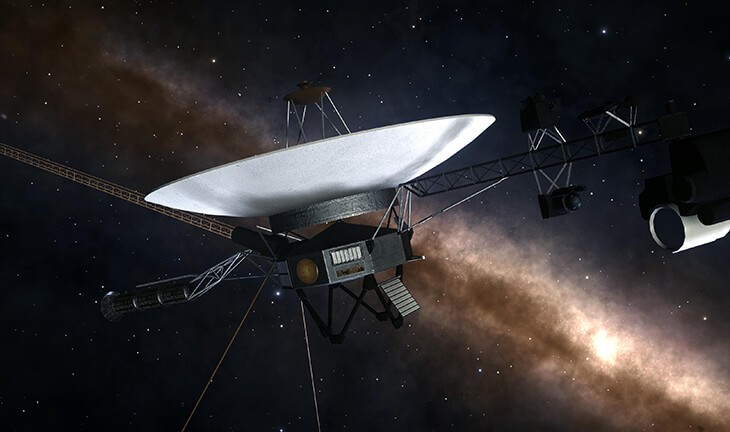
 Visualization of the Kepler telescope near Earth / NASA
Recently, the NASA team discovered that the spacecraft is no longer capable of transmitting information about its damage. Therefore, it has been put into hibernation mode again, this time, according to engineers, until October 10th. The agency does not know exactly how much fuel the telescope has left, but will attempt to transmit as much data as possible to Earth. If this attempt is successful, the spacecraft will resume its search for exoplanets.
At present, the spacecraft is known to have at least three problems. First, its fuel supply is almost depleted. Second, one engine is damaged, but it has seven more. Third, it cannot use all four flywheels to change attitude.
Since August 29, the telescope has studied 30,000 stars and galaxies in the constellation Aquarius. Among them is the TRAPPIST-1 system, which includes seven planets. Astronomers believe that some of them may contain up to 250 times more water than Earth.
One of Kepler’s most intriguing discoveries is the planet Wolf 503b, orbiting a bright star. Twice the size of Earth and well-lit, it is ideal for further study by other telescopes. Wolf 503b is of particular interest to astronomers because there are no similar planets in the Solar System.

 Subscribe to the newsletter







Сообщить об опечатке
Текст, который будет отправлен нашим редакторам: