


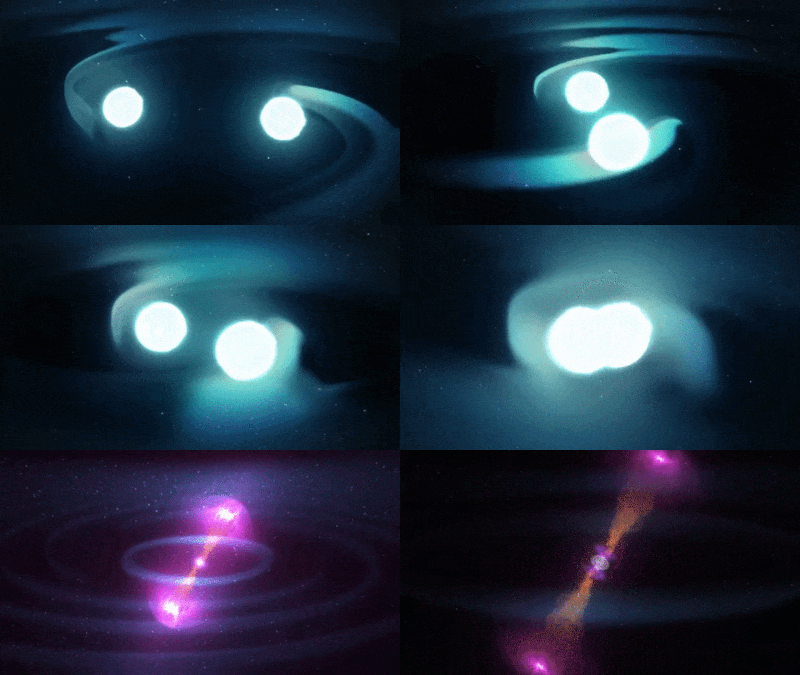
Physicists from the international LIGO and Virgo collaborations have succeeded in detecting gravitational waves for the sixth time. This time, their source was event GW170608, the merger of two black holes that had the smallest masses in history gravitational-wave astronomy, according to a press release on the LIGO collaboration website.

Mass distribution of merging black holes in five gravitational wave detections
LIGO/Caltech/Sonoma State (Aurore Simonnet)
On the evening of June 8, 2017, at 02:01 (UTC), the Laser Interferometer Gravitational-Wave Observatory (LIGO) The LIGO observatory in Livingston, Louisiana, detected the arrival of a gravitational burst from space. The signal was designated GW170608 (signals are designated by the date of detection). Seven milliseconds later, the signal was detected by the second interferometer at the LIGO observatory in Hanford, Washington. The difference in detection times allowed us to estimate the location of the signal source on the celestial sphere within 520 square degrees. An alert about the burst detection was sent to various observatories to search for a possible source of electromagnetic radiation in this region of the sky associated with the burst. The Virgo observatory did not detect this gravitational burst; it was only commissioned on August 1st.

General view of the GW170608 signal recorded by the LIGO observatories
LIGO
Analysis of the signal showed that the binary system consisted of black holes with masses in the ranges Between 5 and 9 solar masses and between 9 and 19 solar masses. The merger produced a new black hole with a mass between 17 and 23 solar masses and a radius between 47 and 63 solar radii, converting approximately 1 solar mass into gravitational wave energy according to Einstein’s formula. The redshift for the signal source is z = 0.04 ~ 0.1, meaning that the gravitational waves reached Earth 0.7-1.5 billion years after the black holes merged.
The masses of black holes before mergers can give astronomers information about what their progenitor stars looked like. As massive stars reach the end of their lives, they lose much of their mass through stellar winds caused by the radiation pressure of the star. The more «heavy» elements, such as carbon and nitrogen, a star contains, the more mass it will lose before collapsing into a black hole. Thus, the progenitor stars of the black holes that produced the GW170608 gravitational burst may have contained relatively large amounts of «heavy» elements compared to the stars that formed more massive black holes, such as the GW150914 gravitational burst.
Gravitational waves are waves of oscillations in the geometry of spacetime, the existence of which was predicted by general relativity. The LIGO collaboration first reported their reliable detection in February 2016, 100 years after Einstein’s predictions, and recently scientists have registered for the first time gravitational waves from the merger of two neutron stars.

 Subscribe to the newsletter
Сообщить об опечатке
Текст, который будет отправлен нашим редакторам: