

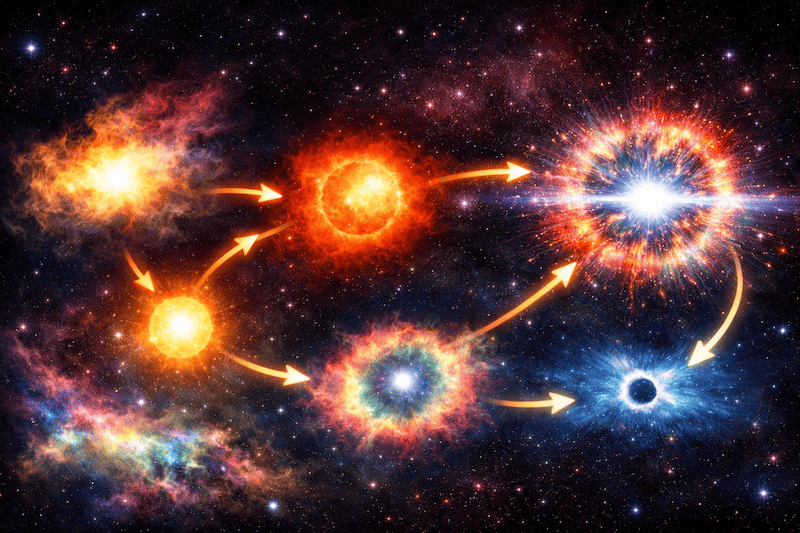
Introduction to the Stellar Life Cycle
Have you ever looked up at the night sky and wondered about the twinkling stars? They might seem like they’ll always be there, shining brightly, but did you know that stars actually have a life cycle just like living things on Earth? In this guide, we will take you on a journey through the fascinating Stellar Life Cycle, from the birth of a protostar to the dramatic explosion of a supernova.
- Formation of a Protostar: It all begins with a massive cloud of gas and dust called a nebula. As gravity pulls this material together, it becomes denser and hotter, eventually forming a protostar.
- Protostar Characteristics and Evolution: The protostar continues to grow as more material is pulled in, spinning faster and gaining heat. This stage can last for tens of thousands to millions of years.
- Initiation of Nuclear Fusion: Once the core temperature reaches about 15 million degrees Celsius, nuclear fusion begins, creating energy that pushes outward against gravity and helps the star maintain its shape.
- Main Sequence Stage of a Star’s Life: The star settles into a stable phase where it balances the inward force of gravity with the outward force of radiation, fueling it for billions of years.
As we delve deeper into the Stellar Life Cycle, we will explore the formation of planetary systems, the red giant phase where a star expands and cools, and the creation of white dwarfs. We will also witness the awe-inspiring event of a supernova, where a massive star meets its fiery end.
By understanding the life cycle of stars, we gain insights into the makeup of the universe and the processes that shape it. Stars play a crucial role in the formation of galaxies and the elements that make up the world around us. Join us on this journey through the Stellar Life Cycle and uncover the wonders of the cosmos.
Formation of a Protostar
When a cloud of gas and dust in space begins to collapse due to gravity, it forms what is known as a protostar. This is the beginning stage of a star’s life cycle, where a new star is born.
As the cloud collapses, the particles within it start to heat up and cluster together. The swirling mass of gas and dust begins to grow hotter and denser, eventually forming a sphere-shaped object. This is the protostar.
- Gravity at Work: Gravity plays a crucial role in this process, pulling the gas and dust inward and causing it to clump together. As more material gathers at the center, the pressure and temperature increase.
- Initial Stage: At first, the protostar is not yet stable. It is still accumulating mass and energy, undergoing various transformations as it develops further.
Over time, as more material is drawn in, the protostar becomes surrounded by a swirling disk of matter. This disk serves as a reservoir from which the protostar can continue to absorb mass and grow larger.
As the protostar continues to gather more material and increase in size, it gradually heats up even more. Eventually, the core of the protostar will reach a critical temperature where nuclear fusion reactions can begin.
This marks the transition of the protostar into the next stage of its evolution, where it becomes a full-fledged star. From here, the star will go through various stages in its lifetime, ultimately shaping the course of its existence within the universe.
Protostar Characteristics and Evolution
Once a cloud of dust and gas has collapsed under its own gravity, a protostar begins to form. At this early stage, a protostar may not yet be hot enough to initiate nuclear fusion, but it is on its way to becoming a fully-fledged star.
Protostars are typically very young and can be surrounded by a disk of rotating material called an accretion disk. This disk plays a crucial role in feeding the growing protostar with additional material, allowing it to grow in size and mass.
As a protostar continues to gravitationally pull material towards itself, it begins to heat up and eventually reaches temperatures high enough to initiate nuclear fusion — the process that powers the inner core of a star for most of its life.
During the protostar stage, the object is still in the process of contracting and accumulating mass. Eventually, the protostar will reach a point where the outward pressure from the fusion reactions balances the inward gravitational force, and the star enters the main sequence phase of its life cycle.
- Protostars are young stars in the process of formation.
- They are surrounded by an accretion disk that helps fuel their growth.
- As protostars gather more material, they heat up and eventually begin nuclear fusion.
- Once the inward gravity is balanced by fusion pressure, the star enters the main sequence phase.
Throughout the evolution of a protostar, it undergoes significant changes as it grows and develops into a stable star. Understanding the characteristics and processes involved in the protostellar phase provides valuable insights into the formation and behavior of stars in our universe.
Initiation of Nuclear Fusion
After millions of years of gravitational collapse and contraction, a protostar reaches a point where its core temperature and pressure become so high that nuclear fusion can begin. Nuclear fusion is the process whereby hydrogen atoms within the star’s core fuse together to form helium, releasing an incredible amount of energy in the process.
This moment marks a significant turning point in the life cycle of a star, as it transitions from being a contracting protostar to a stable main sequence star. The energy produced by nuclear fusion balances the inward pull of gravity, resulting in a delicate equilibrium that can last billions of years.
As hydrogen atoms undergo fusion, they release energy in the form of photons (light) and other particles. This energy radiates outwards, providing the necessary heat and light for the star to shine brightly in the vast expanse of space.
- Formation of helium: The fusion of hydrogen atoms produces helium as a byproduct, gradually building up a supply of helium in the star’s core.
- Energy release: The energy released during nuclear fusion is what sustains the star, keeping it stable and shining for vast periods of time.
- Balancing act: The process of nuclear fusion generates an outward pressure that counteracts the gravitational force pulling the star’s material inward, maintaining its shape and size.
Overall, the initiation of nuclear fusion within a protostar sets the stage for a prolonged and stable main sequence stage, during which the star serves as a source of energy and light in the universe. This crucial process shapes the evolution and fate of the star as it continues on its journey through the stellar life cycle.
Main Sequence Stage of a Star’s Life
After the formation of a protostar and the initiation of nuclear fusion, a star enters what is known as the main sequence stage of its life. This is where the star will spend the majority of its life. During this stage, the star is stable and achieves equilibrium between the outward pressure caused by nuclear fusion and the inward pull of gravity.
Stars in the main sequence stage vary in size, temperature, and brightness. Smaller stars, like red dwarfs, can stay in the main sequence for billions of years, while massive stars, like O-type stars, might only last a few million years in the main sequence.
- Small Stars: Small stars have lower temperatures and luminosities compared to larger stars. They burn their fuel at a slower rate, allowing them to remain in the main sequence for much longer periods of time.
- Medium Stars: Medium-sized stars, like our sun, have intermediate lifespans in the main sequence. They burn their fuel steadily and maintain a stable size and brightness.
- Massive Stars: Massive stars have high temperatures and luminosities, which means they burn through their fuel quickly. They shine bright but have shorter main sequence lifespans.
As a star ages in the main sequence, it continues to convert hydrogen into helium through nuclear fusion. This process produces the energy that keeps the star shining and maintains its stability. Eventually, when a star depletes its hydrogen fuel, it will begin to evolve into the next stage of its life cycle.
Throughout the main sequence stage, stars play a crucial role in maintaining the balance of our universe. They provide the energy and elements necessary for the formation of planets, moons, and other celestial bodies. Their existence shapes the environment in which life can evolve and thrive.
In summary, the main sequence stage is the longest part of a star’s life cycle, where it burns its fuel steadily and maintains stability before transitioning into the next phase of its evolution.
Formation of Planetary Systems
As a star progresses through its life cycle, it has a profound impact on the formation of planetary systems around it. When a protostar begins to form within a cloud of gas and dust, a rotating disk called a protoplanetary disk also forms around it. This disk is made up of remnants of the original interstellar cloud that did not collapse into the star.
Over time, particles within the protoplanetary disk begin to collide and stick together, building larger and larger objects known as planetesimals. These planetesimals continue to grow through accretion, eventually forming planets. The process of planet formation is influenced by the composition of the disk and the distance from the star, with rocky planets forming closer to the star and gas giants forming further out.
- Rocky Planets: Closest to the star, these planets are formed from heavy elements such as silicon and iron that are present in the inner regions of the protoplanetary disk. They have solid surfaces and may have molten cores.
- Giant Planets: Further out in the disk, where lighter elements like hydrogen and helium are more abundant, gas giants can form. These planets have thick atmospheres and massive sizes.
As planets continue to form, they may interact with each other gravitationally, leading to orbital migration and potential collisions. Some large bodies may also become captured as moons by the newly formed planets. The presence of planets in a star’s system can also affect the star itself, influencing its rotation and magnetic activity.
In some cases, if the protoplanetary disk contains enough material, it may also form smaller objects like asteroids and comets. These bodies can impact planets and trigger significant changes in their atmospheres and surfaces over time.
The formation of planetary systems is a crucial aspect of the stellar life cycle, as it provides insight into the diversity and complexity of the universe. Studying these systems helps us understand the conditions necessary for habitable planets and the potential for life beyond our solar system.
Red Giant Phase — Expansion and Cooling of the Star
As a star ages, it goes through different stages, one of which is the red giant phase. During this phase, the star starts to run out of fuel and begins to expand. This expansion causes the outer layers of the star to cool down, which gives the star its red appearance.
This phase occurs in stars similar to our Sun, where hydrogen fusion ceases in the core and instead begins in a shell surrounding the core. The helium produced by this fusion builds up in the core, causing it to contract and heat up while the outer layers continue to expand.
During the red giant phase, the star’s size increases significantly. In fact, a red giant can be hundreds to thousands of times larger than its original size as a main sequence star. This expansion process can cause the star to engulf nearby planets, including potentially our own Earth.
As the star expands and cools, its surface temperature decreases. The cooler temperatures result in the red glow that characterizes red giants. Despite their larger size, red giants are not as hot as main sequence stars, like our Sun, which gives them their distinct red color.
- Surface Features: Red giants often exhibit various surface features, such as spots or eruptions, caused by turbulence within their outer layers. These features give astronomers valuable insights into the internal structure and processes of these aging stars.
- Planetary Systems: The expansion of a red giant can significantly impact any surrounding planetary systems. Depending on the distance of the planets from the star, they may either be swallowed up by the expanding envelope or pushed farther away into new orbits.
- Eventual Fate: Ultimately, red giants will reach the end of their lives and go through dramatic transformations, such as shedding their outer layers to form planetary nebulae or transitioning into white dwarfs.
Observing red giants and studying their evolution provides crucial information about the life cycle of stars and the processes at play within them. It allows us to better understand the fate of our own Sun and the broader implications of stellar life cycles in the universe.
Formation of a White Dwarf
After the red giant phase, a star will eventually shed its outer layers and collapse inward to form a small, dense object known as a white dwarf. A white dwarf is about the size of Earth but has the mass of a star, making it incredibly dense.
As the star runs out of fuel and stops nuclear fusion, the outward pressure that kept the star stable against its own gravity decreases. This causes the star’s core to collapse under its own weight, while the outer layers are blown away in a planetary nebula. What remains is the hot core of the star, which becomes a white dwarf.
- Size: A white dwarf is very small compared to its original size when it was a main sequence star. However, despite their small size, white dwarfs are very massive.
- Temperature: The core of a white dwarf can be incredibly hot, reaching temperatures of over 100,000 degrees Kelvin.
- Luminosity: White dwarfs are not very luminous because they no longer undergo nuclear fusion. They slowly cool down over billions of years, eventually becoming black dwarfs.
- Stability: White dwarfs are stable because they are supported by degenerate electron pressure, where electrons are packed so tightly that they cannot move freely.
White dwarfs are fascinating objects in the universe, representing the final stages of evolution for many stars like our Sun. They have a profound impact on the cosmos, influencing the formation of new stars and planetary systems. Understanding the formation and characteristics of white dwarfs gives us valuable insights into the life cycles of stars and their impact on the universe as a whole.
Supernova Event — Death of a Massive Star
As stars reach the end of their lives, they go out with a bang in a spectacular event known as a supernova. This happens when a massive star has used up all of its nuclear fuel and can no longer support itself against its own gravity.
When this happens, the star collapses in on itself, causing a massive explosion that releases an incredible amount of energy and brightness. The brightness of a supernova can sometimes outshine an entire galaxy for a short period of time!
- Types of Supernovae: There are two main types of supernovae. Type I supernovae occur in binary star systems, where one star is a white dwarf that accumulates material from its companion until it reaches a critical mass and explodes. Type II supernovae, on the other hand, are the explosive deaths of massive stars at the end of their life cycles.
After a supernova explosion, the remnants of the star can either form a neutron star or a black hole, depending on the mass of the original star. Neutron stars are incredibly dense and spinning rapidly, while black holes are regions of space with such a strong gravitational pull that not even light can escape.
Scientists study supernovae to learn more about the life and death of stars and how they shape the universe. Supernovae are also responsible for the creation of many elements that make up our world, such as iron and gold, as they are forged in the extreme pressures and temperatures of these explosive events.
Overall, the supernova event marks the end of a massive star’s life but also the beginning of something new as the remnants contribute to the formation of new stars and planets in the vast expanse of space.
Types of Supernovae
Supernovae are explosive events that mark the death of massive stars, releasing massive amounts of energy and dispersing elements into the universe. There are two main types of supernovae: Type I and Type II.
- Type I Supernovae: These supernovae occur in binary star systems where one star has exhausted its nuclear fuel and is white dwarf. If the white dwarf accretes material from its companion star, it can reach a critical mass limit and undergo a thermonuclear explosion, resulting in a Type I supernova.
- Type II Supernovae: Type II supernovae occur when a massive star, with a mass greater than eight times that of our sun, runs out of nuclear fuel and collapses under its own gravity. The core of the star collapses, leading to a rebound effect that creates a powerful explosion.
While both types of supernovae result in extremely bright and energetic explosions, they differ in their underlying mechanisms. Type I supernovae are classified further into subcategories based on characteristics in their spectral lines, whereas Type II supernovae are characterized by the presence of hydrogen lines in their spectra.
Supernovae are crucial events in the lifecycle of the universe, as they are responsible for creating and dispersing the heavy elements necessary for life as we know it. Elements such as carbon, oxygen, and iron are produced in the extreme conditions of a supernova explosion and are eventually incorporated into new stars, planets, and even living organisms.
Understanding the different types of supernovae and the processes involved in these explosive events is essential for scientists studying the evolution of stars and galaxies. By observing supernovae and analyzing their properties, researchers can gain valuable insights into the cosmic processes that shape our universe.
Expulsion of Supernova Remnants
After a massive star goes supernova, it leaves behind the remnants of its explosive death. These remnants include elements like iron, oxygen, and silicon that were formed in the core during nuclear fusion. The incredible energy released during the explosion also creates shock waves that travel outward, pushing out into space and carrying these elements with them.
- Supernova Remnants: The expanding clouds of gas and dust left behind by a supernova are called supernova remnants. As they continue to spread out into space, these remnants cool down and mix with the surrounding interstellar medium.
- Ejecta: The material expelled during a supernova explosion is known as ejecta. This ejected material contains not only heavy elements produced during the star’s lifetime but also high-energy particles and radiation.
- Impact on Stellar Surroundings: The expulsion of supernova remnants has a significant impact on their surroundings. They can trigger the formation of new stars and planetary systems by enriching the interstellar medium with heavy elements necessary for building rocky planets like Earth.
Over time, these remnants disperse and mix with other elements in the galaxy, contributing to the overall chemical composition of the universe. They enrich the cosmic dust clouds, where new stars will eventually form, with the ingredients necessary for life.
From the death of a massive star comes new life as these remnants go on to seed the universe with the raw materials needed for new stars, planets, and possibly even life itself. The cycle of stellar life continues on, shaping the cosmos we see today.
Conclusion: Implications of Stellar Life Cycles on the Universe
The stellar life cycle plays a crucial role in shaping the universe as we know it. From the birth of a star as a protostar to its eventual death as a supernova, each stage has significant impacts on the surrounding environment and future celestial bodies.
- Formation of a Protostar: The formation of a protostar is the beginning of a star’s life cycle. It signifies the birth of a new star from collapsing gas and dust within a molecular cloud.
- Main Sequence Stage: During the main sequence stage, a star shines brightly due to nuclear fusion in its core. This stage can last for billions of years and is crucial for supporting planetary systems around the star.
- Red Giant Phase: As a star ages and runs out of hydrogen fuel, it expands into a red giant. This phase marks the eventual cooling and eventual death of the star.
- Supernova Event: The death of a massive star in a supernova event leads to the creation of heavy elements and releases an enormous amount of energy. Supernovae are crucial for dispersing elements throughout the universe.
Understanding stellar life cycles helps us comprehend the origins of elements within our universe. Heavy elements such as gold, silver, and iron are formed during supernova explosions, enriching the interstellar medium and seeding future generations of stars and planets.
Moreover, these stellar events have a profound impact on the evolution of galaxies. Supernovae play a key role in regulating the formation of stars and galaxies, influencing their shapes and structures over billions of years.
By studying stellar life cycles, scientists can also gain insight into the eventual fate of our own Sun. Understanding how stars evolve and die allows us to make predictions about the future of our solar system and planet Earth.
In conclusion, the stellar life cycle is not just a series of events happening in distant corners of the universe. Instead, it is an interconnected process that shapes the universe on a grand scale. By unraveling the mysteries of stellar evolution, we can better comprehend our place in the cosmos and appreciate the beauty and complexity of the universe around us.

 Subscribe to the newsletter

Сообщить об опечатке
Текст, который будет отправлен нашим редакторам: