

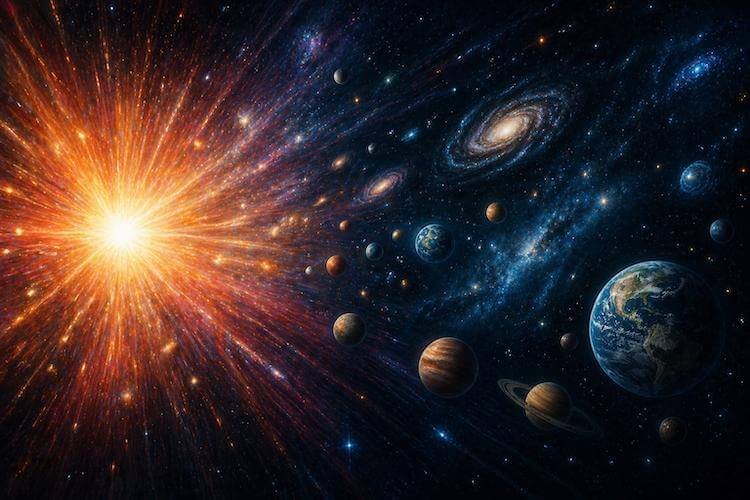
Welcome to the exciting world of The Big Bang Theory! No, we’re not talking about the popular TV show – we’re diving into the fascinating scientific theory that explains how our universe began. Imagine a time when everything that exists today, from stars to planets and galaxies, was squeezed into a tiny, hot, and dense point. This was the beginning of it all, over 13.8 billion years ago.
Scientists believe that this cosmic explosion, known as the Big Bang, set off the chain of events that eventually led to the creation of the vast and awe-inspiring universe we see today. It’s a mind-boggling idea, but it’s supported by some solid evidence and a lot of brainpower from brilliant minds throughout history.
- But who were these key astronomers and scientists who paved the way for the Big Bang Theory? Well, names like Edwin Hubble, Georges Lemaître, and Albert Einstein played crucial roles in developing this mind-blowing concept.
- As we continue exploring, we’ll also learn about the expanding universe – the idea that space itself is stretching out, carrying galaxies away from each other. This expansion helps support the Big Bang Theory and leads us to wonder how it all got started in the first place.
- We’ll delve into the evidence that supports this groundbreaking theory, like the cosmic microwave background radiation, which is lingering energy from the early moments of the universe, and the redshift of galaxies that shows us they are moving away from us.
This introduction scratches the surface of The Big Bang Theory, a scientific marvel that continues to shape our understanding of the universe. So get ready to explore the mysteries of the cosmos and unravel the incredible story of how it all began!
Background on Astronomers and Scientists
Throughout history, there have been many brilliant minds who have contributed to our understanding of the universe and the development of The Big Bang Theory. One of the earliest figures in this story is the famous astronomer Galileo Galilei. In the 17th century, Galileo made groundbreaking discoveries with his telescope, which challenged the prevailing geocentric model of the universe and paved the way for future astronomers.
Another key figure in the history of astronomy is Edwin Hubble, whose observations of galaxies and their redshift provided crucial evidence for the expanding universe. Hubble’s work laid the foundation for what would later become The Big Bang Theory, as his findings supported the idea that the universe is constantly growing and evolving.
- Georges Lemaître: A Belgian physicist and Roman Catholic priest, Lemaître proposed the theory of an expanding universe and was one of the first to suggest the concept of a primeval atom, which later influenced The Big Bang Theory.
- Arno Penzias and Robert Wilson: In the 1960s, these two scientists discovered the cosmic microwave background radiation, a crucial piece of evidence that supported The Big Bang Theory and helped solidify it as the leading explanation for the origin of the universe.
- Stephen Hawking: Widely known for his work in theoretical physics, Hawking made significant contributions to our understanding of black holes and the early universe. He also collaborated on research that further supported The Big Bang Theory.
These are just a few of the many astronomers and scientists who have played a role in shaping our current understanding of the universe and The Big Bang Theory. Their dedicated work and innovative thinking have pushed the boundaries of human knowledge, inspiring new generations to continue exploring the mysteries of the cosmos.
Explanation of the concept of an expanding universe and how it led to the idea of the Big Bang
Imagine the universe as a giant balloon that is slowly inflating. Everything in it is getting farther apart from each other as the balloon expands. This is the basic idea behind the concept of an expanding universe.
In the early 20th century, astronomers like Edwin Hubble made a mind-blowing discovery. They observed that galaxies all around us are moving away from each other at incredible speeds. This observation led to the realization that the universe itself is expanding.
- This is where the Big Bang Theory comes into play. Scientists came up with the idea that if the universe is expanding now, then at one point in the past, everything must have been together in one tiny, dense point. And then, something caused this point to rapidly expand, leading to the creation of the universe as we know it.
Just like a balloon being blown up, the universe started out small and has been expanding ever since. The concept of an expanding universe provides a crucial foundation for the Big Bang Theory. It helps us understand how everything we see in the cosmos today was once part of a single, unimaginably compact point.
By studying the movement of galaxies and measuring the distances between them, scientists can trace back in time to when the universe was just a fraction of its current size. This evidence supports the idea that the universe began with a colossal explosion – the Big Bang.
So, the next time you look up at the night sky and see the stars twinkling above, remember that each one of them is a piece in the puzzle of an expanding universe that started with a bang.
Overview of the evidence supporting the Big Bang Theory
So, you might be wondering, «How do we know that the Big Bang Theory is actually true?» Well, scientists have gathered some pretty convincing evidence to support this groundbreaking idea.
One piece of evidence is something called cosmic background radiation. Imagine tuning your radio to a station that doesn’t have any programs — you’d hear a faint, staticky noise, right? Cosmic background radiation is like that static, but it comes from everywhere in the universe. This radiation is considered a remnant of the energy released during the Big Bang, providing a sort of «echo» of that momentous event.
Another key piece of evidence is the redshift of galaxies. Imagine you’re on a train platform as a train speeds by. As it passes you, the pitch of its horn changes — that’s the Doppler effect. Galaxies in the universe show a similar effect, with their light shifting towards the red end of the spectrum. This redshift is seen as evidence that the universe is expanding, supporting the idea of the Big Bang.
- Cosmic background radiation: echoes of the Big Bang throughout the universe
- Redshift of galaxies: evidence of an expanding universe
By studying these and other pieces of evidence, scientists have built a solid case for the validity of the Big Bang Theory as the most plausible explanation for the origin of the universe.
Discussion of the Timeline of Events Following the Big Bang
So, what happened after the Big Bang? Well, let’s break it down for you in simple terms. After the initial explosion that marked the beginning of the universe, things started to cool down a bit. Slowly, over time, particles began to come together and form atoms like hydrogen and helium.
- This is where stars come into the picture. Once these gases gathered enough mass, gravity took over and triggered nuclear fusion, creating intense heat and light. Voilà, we have stars!
- As these stars lived out their lives, some of them exploded in fiery supernova events, scattering heavier elements like carbon, oxygen, and iron throughout the universe.
- These scattered materials eventually clumped together under the force of gravity, forming galaxies – vast collections of stars, gas, dust, and planetary systems.
- Within these galaxies, more stars were born from the leftover gas and dust. Some of these stars went on to form planets like our own Earth, where life eventually emerged.
So, in a nutshell, the timeline goes something like this: Big Bang → Formation of basic elements → Star formation → Supernova explosions → Galaxy formation → Second generation star and planet formation → Emergence of life.
It’s incredible to think about how all of this came to be from that one explosive moment billions of years ago. The universe is always changing and evolving, and we are just a tiny part of this vast cosmic dance.
Understanding this timeline helps us grasp the grand scale of the universe and our place within it. It’s a humbling reminder of how small and young we are in the grand scheme of things, yet how interconnected we are with everything around us.
Comparison of the Big Bang Theory with other theories of the origin of the universe
When it comes to explaining how the universe began, there are different theories that scientists have proposed over the years. One of the most well-known and widely accepted theories is the Big Bang Theory. But how does it stack up against other ideas about the origin of our universe?
- Steady State Theory: Before the Big Bang Theory gained widespread acceptance, the Steady State Theory was a popular alternative. This theory suggests that the universe has always existed in a constant state, with new matter continuously being created to keep things in equilibrium. However, as more evidence has emerged supporting the Big Bang Theory, the Steady State Theory has fallen out of favor.
- Inflationary Theory: Another theory that is closely related to the Big Bang Theory is the Inflationary Theory. This idea suggests that shortly after the Big Bang, the universe experienced a period of rapid expansion before settling into the more gradual expansion that we observe today. Inflationary Theory helps to explain some of the features of the universe that the Big Bang Theory alone might struggle to account for.
- Multiverse Theory: Some scientists have proposed the idea of a Multiverse, where our universe is just one of many universes that exist in a vast «multiverse.» While this theory is more speculative than the Big Bang Theory, it raises interesting questions about the nature of reality and the possibility of other forms of existence beyond our own.
While the Big Bang Theory is the most widely accepted explanation for the origin of the universe, it is important to recognize that science is always evolving and new evidence could lead to a better understanding of how our universe began. Comparing the Big Bang Theory to other theories can help us to refine our understanding of the cosmos and deepen our appreciation for the complexities of the universe.
Exploration of how the Big Bang Theory aligns with modern cosmological models and observations
The Big Bang Theory has been a cornerstone of modern cosmology, providing a framework for understanding the origin and evolution of the universe. As scientists continue to explore the cosmos through advanced technologies and observations, they have found strong evidence that corroborates the key elements of the Big Bang Theory.
- Cosmic background radiation: One of the most compelling pieces of evidence supporting the Big Bang Theory is the presence of cosmic microwave background radiation. This faint glow permeates the universe and is considered residual heat from the early stages of the Big Bang, providing a snapshot of the universe’s infancy.
- Redshift of galaxies: Another crucial observation that aligns with the Big Bang Theory is the redshift of galaxies. This phenomenon, discovered by astronomer Edwin Hubble, demonstrates that galaxies are moving away from each other, indicating an expanding universe consistent with the predictions of the Big Bang.
Furthermore, modern cosmological models, such as inflation theory and the Lambda-Cold Dark Matter model, have incorporated and expanded upon the foundation laid by the Big Bang Theory. These models account for the large-scale structure of the universe, the distribution of matter, and the cosmic microwave background radiation, providing a more comprehensive understanding of the universe’s evolution.
By synthesizing observational data from telescopes, satellites, and other instruments with mathematical models and theoretical frameworks, scientists have been able to refine our understanding of the cosmos and validate the foundational principles of the Big Bang Theory.
Overall, the alignment of the Big Bang Theory with modern cosmological models and observations underscores the robustness and reliability of this scientific explanation for the origin of the universe. Continued research and technological advancements are likely to further enhance our comprehension of the universe’s history and future trajectory, building upon the enduring legacy of the Big Bang Theory.
Examination of potential criticisms or challenges to the Big Bang Theory
While the Big Bang Theory is widely accepted in the scientific community as the most plausible explanation for the origin of the universe, it is not without its critics and challenges. One of the main criticisms of the theory is the issue of what happened before the Big Bang. Since the theory posits that the universe began as a singularity, it does not address what may have preceded this event.
Another challenge to the Big Bang Theory is the problem of the flatness and horizon puzzles. These puzzles arise from the fact that the universe appears to be very uniform in temperature and density on large scales, despite not having had enough time since the Big Bang for light to travel across the entire universe and equilibrate these properties. Some alternative theories have been proposed to address these puzzles, such as inflationary cosmology.
Additionally, the Big Bang Theory does not yet provide a complete understanding of dark matter and dark energy, two mysterious substances that make up the majority of the universe’s mass-energy content. While dark matter and dark energy are not challenges to the theory itself, they do raise questions about our current understanding of the universe and its composition.
Some critics of the Big Bang Theory also point to discrepancies between the theory and certain astronomical observations, such as the unexpected distribution of galaxies in the universe or anomalous cosmic microwave background radiation patterns. These discrepancies have led some scientists to explore alternative theories, such as modified gravity models, as potential replacements for the Big Bang Theory.
Despite these criticisms and challenges, the Big Bang Theory remains the most successful and widely accepted explanation for the origin and evolution of the universe. Scientists continue to research and refine the theory, addressing the gaps in our knowledge and exploring new ideas to deepen our understanding of the cosmos.
Analysis of the Implications of the Big Bang Theory for Understanding the Nature of the Universe
The Big Bang Theory has profound implications for our understanding of the universe and our place within it. By providing a widely accepted explanation for how the universe began and evolved over time, the Big Bang Theory has revolutionized our perspective on the cosmos.
- Origin of the Universe: The Big Bang Theory suggests that the universe originated from a singularity, a point of infinite density and temperature. This concept challenges our previous notions of a static and unchanging universe.
- Expansion of the Universe: The idea of an expanding universe, supported by observations like cosmic background radiation and redshift of galaxies, indicates that the universe is not only getting bigger but also evolving over time.
- Cosmic Evolution: Following the Big Bang, stars, galaxies, and other celestial structures formed through gravitational interactions. This evolutionary model of the universe helps us understand how different elements and structures came to exist.
- Alignment with Modern Cosmological Models: The Big Bang Theory aligns with modern cosmological models and observational data, supporting its credibility as the most plausible explanation for the origin of the universe.
- Implications for the Nature of the Universe: The Big Bang Theory implies that the universe is not static but constantly changing and evolving. It also suggests a finite age for the universe, raising questions about its ultimate fate.
Ultimately, the Big Bang Theory challenges us to rethink our place in the grand scheme of the universe. It highlights the dynamic and evolving nature of the cosmos, inviting us to explore deeper questions about the origins of life, the existence of extraterrestrial civilizations, and the potential for future cosmic events.
As we continue to study and evaluate the implications of the Big Bang Theory, we gain a deeper understanding of the universe and our place within it. The theory serves as a cornerstone of modern cosmology, shaping our views on the nature of reality and our role in the vast expanse of space.
Discussion of ongoing research and advances in the field of cosmology related to the Big Bang Theory
Scientists and researchers are constantly studying and discovering new insights into the Big Bang Theory and its implications for our understanding of the universe. Ongoing research in cosmology continues to reveal exciting new findings that shed light on the origins and evolution of the cosmos.
- Cosmic Microwave Background Radiation (CMB): One area of focus for researchers is studying the cosmic microwave background radiation, which is considered by many as tangible evidence of the Big Bang. By analyzing the CMB, scientists can learn more about the early universe and its properties, helping to validate and refine the Big Bang Theory.
- Dark Matter and Dark Energy: Another key area of research is the study of dark matter and dark energy, which are believed to make up a significant portion of the universe. Understanding these mysterious components is essential for developing a comprehensive understanding of the universe’s structure and evolution since the Big Bang.
- Particle Physics and Quantum Theory: Advances in particle physics and quantum theory have also contributed to our understanding of the Big Bang Theory. By exploring the fundamental building blocks of matter and the forces that govern them, scientists can gain insight into the conditions of the early universe and how it evolved over time.
- Cosmic Inflation and Multiverse Theories: Some researchers are studying the concept of cosmic inflation, a theory that suggests the universe underwent a rapid period of expansion immediately after the Big Bang. Additionally, the idea of a multiverse, in which there are multiple universes existing parallel to our own, is an intriguing area of exploration that may offer new perspectives on the origins of the cosmos.
Overall, ongoing research and advances in the field of cosmology related to the Big Bang Theory continue to push the boundaries of our knowledge and deepen our understanding of the universe. By collaborating across disciplines and incorporating new technologies and methodologies, scientists are unlocking the mysteries of the cosmos in ways that were once thought impossible.
Concluding thoughts on the significance of the Big Bang Theory in our contemporary understanding of the universe
The Big Bang Theory has revolutionized our understanding of the universe and its origins. It provides a comprehensive framework for how our universe began and how it has evolved over billions of years. By studying the evidence and implications of this theory, we can gain valuable insights into the nature of the cosmos and our place within it.
- Profound Origins: The Big Bang Theory offers a compelling explanation for the origin of the universe, suggesting that everything we see today emerged from a single point of unimaginable density and energy. This concept challenges our preconceptions about the universe and invites us to consider the grandeur of its inception.
- Cosmic Evolution: Through the timeline of events following the Big Bang, we can trace the formation of stars, galaxies, and other celestial bodies. This narrative helps us appreciate the dynamic nature of the universe and how it has continuously transformed over time.
- Scientific Advancements: The evidence supporting the Big Bang Theory, from cosmic background radiation to the redshift of galaxies, has paved the way for significant advancements in cosmology. Scientists are continually refining our understanding of the universe based on this foundational theory.
- Interpretative Challenges: While the Big Bang Theory has had tremendous success in explaining the universe’s origins and evolution, it is not without its criticisms and challenges. Some aspects of the theory remain unresolved or subject to ongoing research and debate.
Overall, the Big Bang Theory serves as a cornerstone of modern cosmology, shaping how we view the universe and our place within it. By exploring its significance and implications, we can deepen our appreciation for the wonders of the cosmos and the remarkable journey that has brought us to this point in cosmic history.
Resources for Further Reading and Exploration of the Topic
After delving into the fascinating world of The Big Bang Theory and the Origin of the Universe, you may be eager to continue your exploration. Luckily, there are a plethora of resources available to satisfy your curiosity and deepen your understanding.
- Books: Consider diving into books written by experts in the field such as «The Big Bang Theory: A Ladybird Expert Book» by Jim Al-Khalili or «Big Bang: The Most Important Scientific Discovery of All Time and Why You Need to Know About It» by Simon Singh.
- Documentaries: Watching documentaries can provide a visual and auditory exploration of the Big Bang Theory. Check out programs like «Through the Wormhole with Morgan Freeman» or «The Universe» series on platforms like Netflix or streaming services.
- Online Courses: Platforms like Coursera, Khan Academy, and MIT OpenCourseWare offer online courses related to astrophysics and cosmology that can deepen your understanding of the Big Bang Theory.
- Websites: Websites like NASA’s official site, the European Space Agency (ESA), and scientific journals like Nature or Science often publish cutting-edge research articles and news updates related to cosmology and the Big Bang Theory.
- Podcasts: Listening to podcasts can be a fun and informative way to learn more about the Big Bang Theory while going about your day. Check out podcasts like «StartUp Podcast: Explaining the Universe,» «Space Time,» or «NASA’s Guide to Black Holes.»
- Museums and Planetariums: Visiting museums or planetariums that have exhibits on space and astronomy can provide a hands-on learning experience. Many institutions offer interactive displays and guided tours on cosmological topics like the Big Bang Theory.
By exploring these resources and embarking on your own journey of discovery, you can continue to unravel the mysteries of the universe and gain a deeper appreciation for the awe-inspiring origins of our cosmos.

 Subscribe to the newsletter

Сообщить об опечатке
Текст, который будет отправлен нашим редакторам: