

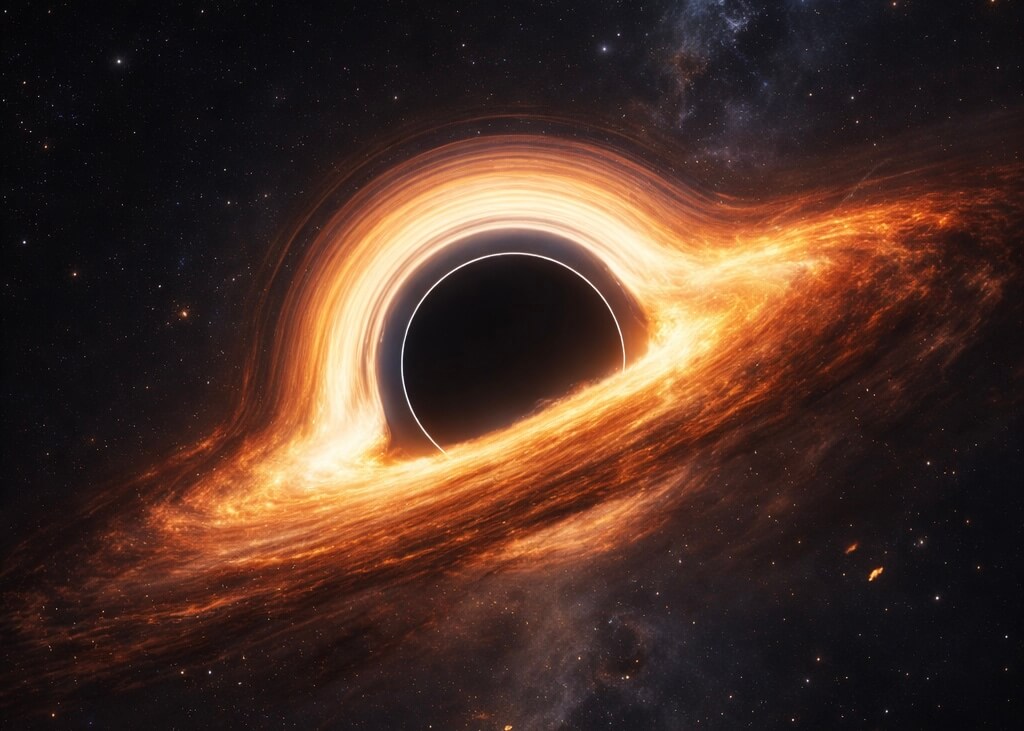
Black holes already sound strange enough — regions in space where gravity is so strong that not even light can escape. But one of their most mind-bending effects isn’t about matter disappearing. It’s about something much more personal:
Time itself behaves differently near a black hole.
And no, this isn’t science fiction. It’s real physics.
First, Let’s Break a Myth: Time Isn’t Constant
We usually think time flows the same everywhere. One second here equals one second anywhere in the universe. Simple.
Except it isn’t true.
According to Einstein’s theory of relativity, gravity affects time. The stronger the gravity, the slower time moves.
On Earth, gravity is relatively mild, so we don’t notice this effect. But near extremely massive objects, the difference becomes dramatic.
“Gravity doesn’t just pull on matter — it pulls on time itself,” physicists often explain.
What Makes Black Holes Special?
A black hole forms when a massive star collapses under its own gravity, compressing huge amounts of mass into an incredibly small region. The result is gravity so intense that space and time become severely distorted.
Imagine placing a heavy bowling ball on a trampoline. The fabric bends. Now imagine something so heavy that the trampoline stretches almost infinitely downward. That’s roughly what a black hole does to space and time.
So What Happens to Time Near One?
Here’s where things get wild.
If a spaceship approached a black hole while you watched from far away, you’d notice something strange. As the ship got closer, its clocks would appear to tick more slowly.
From your point of view, time for the astronauts would nearly freeze as they approached the edge of the black hole, known as the event horizon.
But inside the spaceship, everything would feel normal. The crew wouldn’t feel time slowing. Their watches and heartbeats would continue as usual.
Both views are correct — and that’s the strange beauty of relativity.
Could Someone Travel Into the Future This Way?
In theory, yes.
If astronauts spent time orbiting close to a black hole and then returned home, less time would have passed for them than for people on Earth. They could come back to find decades or even centuries gone.
In other words, extreme gravity acts like a one-way ticket into the future.
But There’s a Catch
Black holes are not tourist destinations. The same gravity that slows time would also stretch objects dramatically in a process scientists call “spaghettification.” The difference in gravity between your head and feet would pull you apart long before you reached the centre.
So while time travel might be possible in theory, survival would be another story.
Why This Matters Beyond Curiosity
Understanding how gravity affects time isn’t just academic. Even modern technology must account for smaller versions of this effect.
GPS satellites orbit Earth where gravity is slightly weaker, meaning their clocks tick faster than clocks on the ground. Engineers must correct for this difference, or navigation systems would drift by kilometres each day.
In other words, relativity isn’t abstract — it quietly helps your phone know where you are.
A Universe Stranger Than Fiction
Black holes remind us that reality is often stranger than imagination. Near them, time stretches, light bends, and the familiar rules of everyday life fall apart.
And perhaps the most fascinating part is this: these aren’t speculative ideas. They are measurable, testable effects confirmed by decades of observations.
The universe, it turns out, is far weirder — and far more interesting — than we once believed.

 Subscribe to the newsletter



Сообщить об опечатке
Текст, который будет отправлен нашим редакторам: