


By determining the movements of individual stars in the nearby Sculptor Dwarf Galaxy for the first time, astronomers have obtained new data on the distribution of the invisible dark matter permeating our galaxy. The study combined star position data obtained by the European Space Agency’s Gaia mission with similar data collected by the Hubble Space Telescope twelve years earlier.
The Sculptor Dwarf Galaxy is one of the many satellite galaxies of the Milky Way. These satellite galaxies interact gravitationally with our own galaxy, and this interaction significantly influences their shape.
In a new study, a team of scientists led by Davide Massari of the Kapteyn Institute for Astronomy in the Netherlands determined the motion of stars in the Sculptor Galaxy in three dimensions by combining measurements of the stars’ proper and radial motions.
The proper motion of stars is the change in the coordinates of stars on the celestial sphere. To determine the speed of this motion, Massari’s team analyzed changes in the positions of stars measured by the Hubble Space Telescope in 2002 and the Gaia mission in 2014-2015. The velocities of the radial motion of stars in the Sculptor Galaxy, that is, their motion along the line of sight, were found from the literature. Using data on the proper and radial motions of stars, scientists were able to reconstruct their motion in three dimensions.
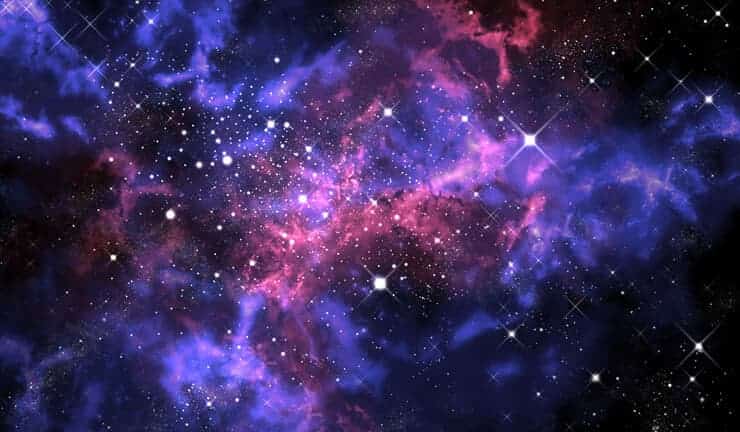
Credit: NASA, ESA, J. Dalcanton and B. Williams (University of Washington), T.A. Rector/University of Alaska Anchorage, T. Abbott, and NOAO/AURA/NSFStars in galaxies are accelerated by the gravitational pull of massive material objects. However, the large body of data on the velocity distribution of stars in galaxies, accumulated by astronomers over the past decades, shows that normal matter alone is insufficient to explain the observed motion of stars. This has led to the hypothesis that, in addition to normal, visible matter, galaxies also contain a special substance called dark matter, which is undetectable by observations but exerts a gravitational influence on galactic objects.
An analysis of the velocities of stars in the Sculptor Galaxy conducted by Massari’s team revealed that dark matter in the galaxy is distributed with increasing density toward the center of the galaxy. This distribution is in good agreement with the results of large-scale simulations of the distribution of dark matter in the Universe, carried out based on the standard cosmological scenario.
The work was published in the journal Nature Astronomy.
Read also:
Interstellar object from another solar system
Gravitational waves allowed scientists to see the merger of neutron stars for the first time stars
Elon Musk plans rocket flights from London to New York in 29 minutes


 Subscribe to the newsletter


Сообщить об опечатке
Текст, который будет отправлен нашим редакторам: