

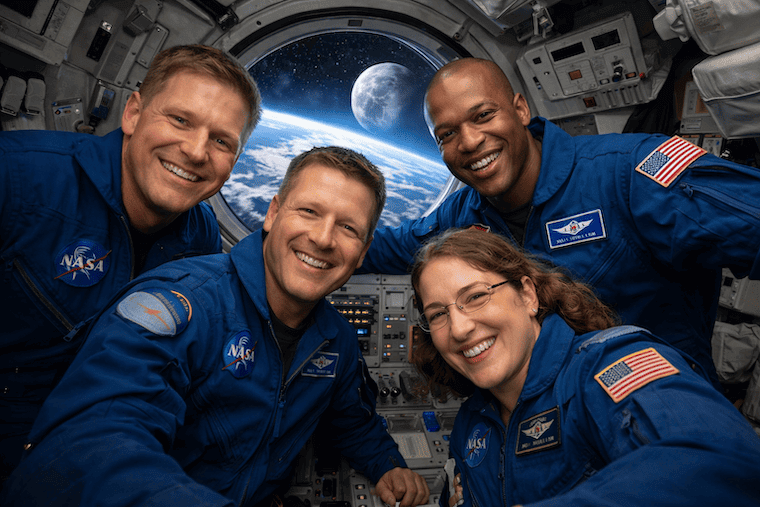
Humanity leaves Earth orbit again — and astronauts say it was “spectacular”
For the first time since the Apollo program, humans have travelled beyond Earth’s orbit — and the crew of Artemis II say the moment was nothing short of “spectacular”.
As the Orion spacecraft performed its critical burn to leave Earth’s gravitational influence, astronauts experienced what many are now calling a once-in-a-generation milestone.
“Nothing prepares you for that view,” one crew member said, describing the instant Earth began shrinking into the darkness of space.
The exact moment everything changed: leaving Earth behind
The defining event of the mission was the translunar injection (TLI) — a precisely timed engine burn that pushed the spacecraft onto a trajectory toward the Moon.
At that moment:
- Earth stopped being “home base” and became a distant object
- the crew crossed into deep space (cislunar space)
- the psychological shift from orbit to exploration became real
This is the same type of manoeuvre used during the Apollo era — but now powered by modern systems developed by NASA.
For the astronauts, it wasn’t just technical — it was deeply emotional.
“We were glued to the windows”
One of the most striking details shared by the crew was how they reacted immediately after leaving orbit.
They described:
- watching Earth as a fully visible sphere
- seeing both daylight and night at once
- spotting auroras and weather systems from space
“We were glued to the windows,” one astronaut said, unable to look away from the rapidly changing view.
As distance increased, Earth transformed into what astronauts often call the “blue marble” — a fragile, isolated world suspended in black space.
Why this moment is historic
This is not just another space mission.
Artemis II marks:
- the first crewed mission beyond low Earth orbit since 1972
- a critical test for future Moon landings
- a key step toward human missions to Mars
Unlike Apollo, this mission is part of a long-term international strategy, involving partners like Canadian Space Agency.
It’s also designed to validate systems that will support sustained human presence beyond Earth.
What astronauts see in deep space
Once outside Earth’s orbit, the visual experience changes dramatically:
- Earth becomes smaller with every hour
- the Moon appears more defined and dominant
- sunlight becomes harsher, shadows deeper
Astronauts described the contrast as “breathtaking”, highlighting how different space feels once you leave Earth’s immediate environment.
A turning point for space exploration
The success of Artemis II is a major signal that humanity is entering a new phase of exploration.
The mission lays the groundwork for:
- Artemis III — returning humans to the lunar surface
- long-term lunar bases
- eventual missions to Mars
For the UK and global audience, this represents more than science — it’s the reopening of deep space travel as a real, ongoing endeavour.
Why this story is trending right now
Search interest is rapidly growing around:
- “Artemis II astronauts experience”
- “leaving Earth orbit moment”
- “deep space human mission 2026”
The emotional angle — astronauts describing what they felt — is driving massive engagement across news and social platforms.
The bigger picture
The “spectacular moment” described by Artemis II astronauts is more than a headline.
It represents:
- humanity stepping beyond Earth again
- a bridge between past (Apollo) and future (Mars)
- a reminder of how small — and unique — our planet really is
And for the first crew in half a century to make that journey, it’s a moment that defines a generation.

 Subscribe to the newsletter







Сообщить об опечатке
Текст, который будет отправлен нашим редакторам: