

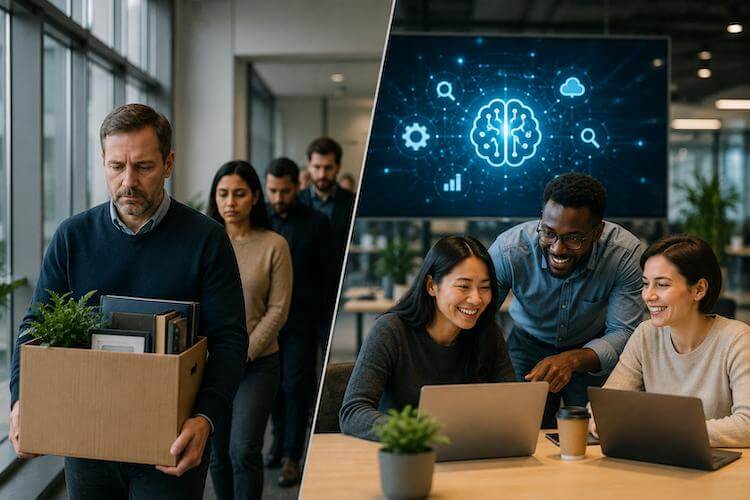
The global job market is entering a new phase of transformation, where artificial intelligence is no longer just a tool — it is becoming a key factor in hiring decisions, corporate restructuring, and long-term business strategy.
One of the clearest examples of this shift recently came from General Motors, which reportedly laid off hundreds of IT employees while simultaneously prioritizing the recruitment of professionals with advanced AI-related skills.
The decision signals a broader transition happening across the technology and enterprise sectors: companies are no longer simply digitizing operations — they are rebuilding their workforce around AI-native capabilities.
Why GM Is Restructuring Its IT Workforce
According to multiple industry reports, the layoffs affected more than 600 employees within GM’s technology division. However, this was not a traditional cost-cutting measure. The company continues to actively hire specialists in areas connected to artificial intelligence, automation, cloud infrastructure, and advanced data systems.
Among the most demanded competencies are:
- AI-native software development
- Prompt engineering
- Machine learning integration
- Cloud and infrastructure engineering
- Data engineering and analytics
- AI workflow architecture
- Autonomous systems development
This reflects a major strategic shift. Traditional enterprise IT departments are evolving into AI-driven innovation centers where software, automation, and intelligent systems are becoming central to business operations.
Modern corporations increasingly require professionals capable of designing ecosystems where humans and AI systems work together efficiently — not simply employees who can operate existing software tools.
The Automotive Industry Is Becoming a Software Industry
Over the past decade, the automotive sector has rapidly transformed into one of the world’s most technology-driven industries.
Today’s vehicles are no longer viewed solely as mechanical products. They are increasingly becoming connected computing platforms powered by software, sensors, cloud systems, and AI-based decision-making technologies.
As a result, major automotive manufacturers are investing billions into:
- Autonomous driving technologies
- AI-assisted navigation systems
- Connected vehicle ecosystems
- Predictive maintenance platforms
- Cloud-based services
- Intelligent driver assistance systems
This transition is fundamentally changing the type of talent companies need. Businesses that once focused primarily on mechanical engineering are now competing for AI engineers, data architects, and software infrastructure specialists.
The Rise of “Skills Replacement”
GM’s restructuring highlights a growing phenomenon often described as “skills replacement.”Instead of reducing staff solely to lower operational costs, companies are increasingly replacing traditional roles with AI-oriented specialists capable of automating processes, integrating intelligent systems, and optimizing workflows through machine learning technologies.
In previous years, employers prioritized:
- Experience with specific programming languages
- Traditional enterprise software expertise
- Long-term corporate experience
- Today, demand is shifting toward:
- AI system integration
- Large language model workflows
- Automation architecture
- Prompt engineering
- AI-assisted development pipelines
- Human-AI collaboration systems
This transformation is reshaping the global labor market at an unprecedented pace.
AI Skills Are Becoming a New Form of Professional Literacy
Recent labor market studies indicate that candidates with AI-related expertise are significantly more likely to receive interview invitations and attract employer attention compared to professionals without these competencies.
Artificial intelligence is gradually becoming what digital literacy once was in the early internet era — a baseline expectation rather than a specialized advantage.
At the same time, the rapid adoption of AI is generating debate across the technology industry.
Experts continue discussing critical questions:
- Will AI replace mid-level developers?
- Are companies overestimating the short-term impact of AI tools?
- Can businesses maintain quality and innovation while aggressively automating workflows?
- Will AI-driven restructuring create long-term instability in the labor market?
The answers remain uncertain, but one trend is already clear: organizations are redesigning their hiring strategies around AI capabilities.
A Defining Moment for the Future of Work
The situation surrounding GM reflects a much larger global transformation.
Corporations across multiple industries are moving from traditional digital transformation toward fully AI-first business models. This shift is changing not only technologies, but also organizational structures, team composition, and the future definition of professional expertise.
Several major trends are now emerging:
1. Smaller Traditional Teams
Automation reduces the need for repetitive development and operational roles.
2. Higher Demand for Hybrid Specialists
Companies increasingly seek professionals who combine:
- Technical knowledge
- Business thinking
- AI understanding
- Product strategy
- Systems architecture expertise
3. Pressure on Predictable Roles
Standardized and repetitive tasks are becoming the most vulnerable to automation.
4. Growing Importance of Strategic Thinking
While AI can automate execution, businesses still depend heavily on specialists capable of building long-term systems, products, and innovation strategies.
The Beginning of an AI-Native Economy
Artificial intelligence is no longer an experimental technology limited to research labs or startups. It is rapidly becoming part of the operational foundation of the world’s largest corporations.
The restructuring inside General Motors may ultimately be remembered as more than a workforce adjustment. It could represent a defining moment in the transition toward an AI-native global economy — one where adaptability, AI literacy, and systems thinking become the most valuable professional assets of the modern era.

 Subscribe to the newsletter







Сообщить об опечатке
Текст, который будет отправлен нашим редакторам: