

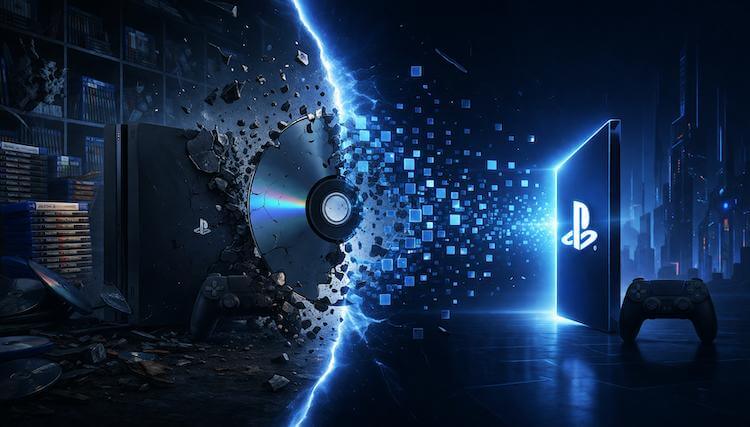
For more than three decades, buying a new PlayStation game meant walking into a shop, picking up a boxed copy and adding another disc to your collection. That tradition is now approaching its end.
Sony Interactive Entertainment has confirmed that beginning in 2028, all newly released first-party PlayStation titles will be distributed exclusively through digital channels, marking one of the most significant shifts in the history of the video game industry. While previously released titles and games scheduled before the transition will continue to receive physical editions, the long-term direction is clear: PlayStation is becoming an entirely digital ecosystem.
The announcement reflects far more than a change in distribution. It represents a fundamental transformation in how games are sold, owned and preserved.
Why Sony Is Moving Away from Physical Media
The primary driver behind Sony’s decision is changing consumer behaviour.
Over the past decade, digital purchases have steadily overtaken physical sales across the gaming industry. Millions of PlayStation owners now buy games directly through the PlayStation Store, downloading new releases without ever visiting a retailer.
From Sony’s perspective, the economics are compelling.
Producing Blu-ray discs, manufacturing cases, printing artwork, shipping products worldwide and maintaining retail partnerships all add significant costs to every physical release. Digital distribution removes virtually all of these expenses while allowing publishers to retain a greater share of revenue.
The digital model also enables simultaneous global launches, faster software updates and greater flexibility in pricing and promotional campaigns.
For Sony, the transition is not simply about technology—it is about building a more efficient and profitable business model.
The End of Ownership as Players Know It
While digital distribution offers convenience, it also changes the relationship between consumers and the products they purchase.
A physical copy can be resold, lent to a friend, collected or preserved indefinitely. It remains playable even if an online storefront eventually disappears.
Digital purchases work differently.
In most cases, consumers purchase a licence to access software rather than permanent ownership of the game itself. Continued access depends on digital infrastructure, user accounts and licensing agreements.
This distinction has become increasingly important as digital platforms across the entertainment industry have occasionally removed previously purchased content following changes to distribution rights.
For many players, the disappearance of physical editions raises concerns about long-term ownership, consumer rights and digital permanence.
The Growing Challenge of Video Game Preservation
Beyond commercial considerations lies a broader issue receiving increasing attention from researchers and archivists: digital preservation.
Video games are now widely recognised as an important form of cultural and technological heritage. However, preserving modern games is considerably more challenging than preserving books, films or physical media.
Many contemporary titles rely on authentication servers, cloud-based infrastructure and online services. If these systems are discontinued, future generations may lose access to significant parts of gaming history, regardless of whether consumers originally paid for the software.
Physical media has historically provided an additional layer of preservation. As the industry moves towards fully digital distribution, responsibility for safeguarding gaming history increasingly falls on publishers and digital archives.
This has become a growing area of discussion within academic research focused on digital heritage and software preservation.
Consumer Reaction Remains Divided
Sony’s announcement has generated mixed reactions across the gaming community.
Many consumers welcome the convenience of instant downloads, automatic updates and the ability to access their entire library without changing discs.
Others see the transition as another step towards reducing consumer control.
Collectors, independent retailers and advocates for digital ownership rights argue that eliminating physical editions removes important freedoms, including the ability to trade, lend or preserve purchased games independently of platform holders.
The second-hand games market, which has long provided affordable access to new releases for many households, is also expected to decline further as digital-only distribution becomes the industry standard.
A Trend That Extends Beyond PlayStation
Sony’s decision should not be viewed in isolation.
PC gaming has already become overwhelmingly digital, while mobile gaming has operated without physical media for years. Subscription services, cloud gaming and digital storefronts continue to redefine how software is distributed across the entertainment sector.
PlayStation’s move is therefore less a radical departure than the latest milestone in a broader industry-wide transition.
Other console manufacturers may eventually follow a similar path as consumer habits continue to evolve.
What Happens Next?
The shift away from physical media is unlikely to happen overnight.
Collectors’ editions, limited-run releases and specialist publishers may continue producing boxed versions for enthusiasts. However, these products are increasingly becoming niche items rather than the industry standard.
For the wider market, digital distribution appears set to become the dominant model for the foreseeable future.
The challenge for platform owners will be balancing commercial efficiency with consumer trust, ensuring that players retain reliable long-term access to the games they purchase.
Conclusion
Sony’s decision marks the end of an era that began with the original PlayStation in the mid-1990s. Physical game discs helped define console gaming for generations, creating thriving markets for collectors, retailers and second-hand sales.
The move towards a fully digital ecosystem promises lower distribution costs, greater convenience and improved operational efficiency. At the same time, it raises important questions about digital ownership, preservation, consumer rights and the future accessibility of interactive media.
Whether viewed as inevitable technological progress or the loss of an important part of gaming culture, one thing is clear: the age of physical PlayStation games is drawing to a close, and the wider games industry is likely to follow.

 Subscribe to the newsletter



Сообщить об опечатке
Текст, который будет отправлен нашим редакторам: