

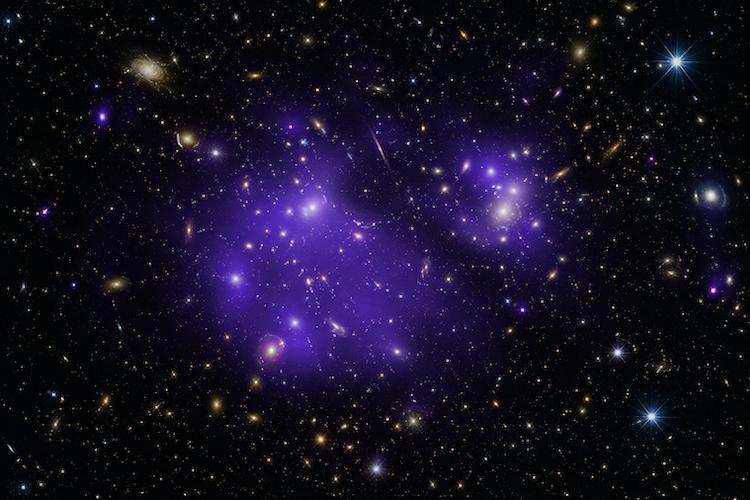
Imagine looking up at the night sky, seeing the countless stars twinkling and galaxies swirling in the vast expanse of space. What we can see with our eyes and telescopes is just a fraction of what makes up the universe. Enter dark matter.
Dark matter is a mysterious substance that doesn’t emit, absorb, or reflect light, making it invisible to our current methods of detection. Despite this invisibility, dark matter has a gravitational pull that affects the movements of stars and galaxies on a cosmic scale.
- Defined simply, dark matter is a type of matter that does not interact with the electromagnetic force and, therefore, cannot be seen through telescopes or other instruments that rely on light.
- Its significance lies in its abundance in the universe, outweighing ordinary matter by nearly five times. This means that dark matter plays a critical role in shaping the structure of galaxies and driving the cosmic dance we observe.
Why should we care about something we can’t see or touch? Well, understanding dark matter could unlock some of the biggest mysteries of the universe, such as how galaxies formed, why they are arranged the way they are, and ultimately, how the universe itself came into being.
Researchers are obsessed with dark matter because it holds the key to answering questions that have puzzled us for centuries. By studying dark matter, scientists hope to gain insights into the nature of the cosmos and our place within it.
Although dark matter remains elusive and enigmatic, its presence and influence are undeniable. This invisible force may hold the secrets to unlocking the mysteries of the universe, making it a topic of fascination and intrigue among scientists and cosmologists alike.
History of Dark Matter Research
Humans have wondered about the mysteries of the universe for as long as we can remember. But it wasn’t until the early 20th century that scientists started to unlock some of those secrets. One of the most intriguing puzzles that researchers have been trying to solve is the existence of dark matter.
It all began in the 1930s when Swiss astronomer Fritz Zwicky noticed something strange while observing the Coma Cluster of galaxies. He noticed that the visible matter in the cluster, such as stars and gas, couldn’t account for the gravitational forces holding the cluster together. This discrepancy led Zwicky to propose the presence of unseen matter — dark matter — that was responsible for the additional gravitational pull.
Over the years, further observations of galaxy rotations and the cosmic microwave background radiation reinforced the existence of dark matter. Scientists realized that dark matter makes up about 85% of all matter in the universe, yet we still know very little about it.
- In the 1970s, astronomer Vera Rubin’s groundbreaking work on galaxy rotation curves showed that stars on the outskirts of galaxies were moving too quickly to be held together by visible matter alone, suggesting the presence of dark matter.
- In the 1990s, the collaboration between astrophysicists and particle physicists further solidified the theory of dark matter by proposing candidate particles, such as weakly interacting massive particles (WIMPs), which could make up dark matter.
These pivotal moments in dark matter research have paved the way for a deeper understanding of the universe’s structure and evolution. Today, scientists continue to study dark matter through various observational and experimental techniques in the hopes of unraveling its mysteries and unlocking the secrets of the cosmos.
By tracing back the history of dark matter research, we can see how far we’ve come in our quest to understand the hidden forces that shape our universe. The journey to uncover the nature of dark matter is far from over, but with each discovery, we are one step closer to demystifying this enigmatic substance that holds the key to the universe’s most profound secrets.
The concept of dark matter: explaining how dark matter interacts with ordinary matter and its peculiar properties
Dark matter is a mysterious substance that makes up about 27% of the universe. Unlike ordinary matter, which is made up of protons, neutrons, and electrons, dark matter does not interact with light and is invisible to telescopes.
One of the peculiar properties of dark matter is that it does not emit, absorb, or reflect light, making it extremely difficult to detect. Scientists have relied on indirect methods, such as observing the gravitational effects of dark matter on visible objects in space, to study its presence.
- Interactions with ordinary matter: Dark matter rarely interacts with regular matter, except through gravity. This means that dark matter can pass through ordinary matter, such as planets and stars, without being affected.
- Gravitational effects: Dark matter’s gravitational pull is what scientists use to detect its presence. The gravitational effects of dark matter can be seen in the movements of stars in galaxies, the bending of light around clusters of galaxies, and the overall structure of the universe.
- Clustering properties: Dark matter is believed to clump together in halos around galaxies, providing the scaffolding for the formation of galaxies and other cosmic structures. Without the gravitational influence of dark matter, galaxies would not be able to maintain their shape and structure.
Although dark matter remains enigmatic, its interactions with ordinary matter play a crucial role in shaping the cosmos and the evolution of the universe. By studying the properties of dark matter and how it interacts with visible matter, scientists hope to unravel the mysteries of the universe and gain a deeper understanding of the forces that govern our cosmos.
Dark Matter vs. Ordinary Matter
So, what exactly is dark matter, and why are scientists so fascinated by it? Well, to put it simply, dark matter is kind of like the invisible ninja of the universe. It’s there, but we can’t see it with our eyes or with telescopes. In fact, dark matter makes up about 85% of all the matter in the universe, while the stuff we’re familiar with, like stars and planets, only make up a measly 15%. Talk about a hidden powerhouse!
Now, let’s chat about some key differences between dark matter and ordinary matter, the stuff we interact with daily.
- Visibility: Ordinary matter reflects, emits, or absorbs light, making it visible through telescopes. In contrast, dark matter is invisible because it doesn’t interact with light in the same way. Scientists can’t directly observe dark matter, which adds to the mystery surrounding it.
- Composition: Ordinary matter is made up of particles like protons, neutrons, and electrons. Dark matter, on the other hand, consists of exotic particles that don’t behave like the ones we’re used to.
- Interactions: When it comes to interacting with other matter, dark matter likes to stay to itself. Unlike ordinary matter, dark matter doesn’t clump together to form stars and planets. It tends to spread out evenly throughout the universe, holding galaxies together in a cosmic dance.
- Effects on Motion: While ordinary matter affects the movement of galaxies and stars due to its gravitational pull, dark matter plays a significant role in galaxies’ rotations and structures. Without dark matter, galaxies would not hold together as they do, hinting at its vital role in star formation and cosmic evolution.
As you can see, dark matter is quite different from the everyday matter we encounter. Its elusive nature and mysterious properties have captured the imagination of countless scientists and researchers who are tirelessly working to unravel its secrets.
How do scientists detect dark matter?
Scientists have developed a variety of methods to study and detect dark matter, even though it cannot be seen or directly observed. One common approach is through gravitational lensing, which involves observing the bending of light from distant galaxies due to the presence of dark matter. By studying these distortions in the light, researchers can map out the distribution of dark matter in the universe.
Another method used to detect dark matter is through indirect detection. This involves looking for signs of dark matter annihilation or decay, which could produce high-energy particles such as gamma rays. By analyzing the radiation emitted from regions where dark matter is suspected to be present, scientists can infer its existence.
Astronomers also rely on simulations and computer modeling to simulate the behavior of dark matter in the cosmos. By comparing these models with observational data, researchers can refine their understanding of dark matter’s properties and distribution.
- Detection in particle accelerators: Some scientists are searching for dark matter particles in high-energy collisions at facilities like the Large Hadron Collider. These experiments aim to create conditions that could reveal the elusive dark matter particles.
- Direct detection experiments: Researchers have also built detectors deep underground to search for dark matter particles interacting with ordinary matter. These experiments look for rare interactions that may provide clues about the nature of dark matter.
- Astrophysical observations: Telescopes and observatories study phenomena such as the rotation curves of galaxies and the cosmic microwave background to gather indirect evidence of dark matter’s influence on the universe.
While the hunt for dark matter continues, scientists are exploring new technologies and innovative approaches to uncover the secrets of this mysterious substance. By combining different detection methods and theoretical frameworks, researchers hope to unlock the mysteries surrounding dark matter and its role in shaping the universe.
The mystery of dark matter: exploring why scientists are puzzled by the nature of dark matter and its elusive nature
Dark matter has captured the imaginations of scientists for decades, as they grapple with understanding its enigmatic nature. One of the main reasons why dark matter remains a mystery is because it does not interact with light or other electromagnetic radiation, making it invisible and undetectable with current technology.
Imagine trying to find an object in a room that does not give off any light or sound — it’s like searching for a needle in a haystack! This has led scientists to come up with clever methods to indirectly study dark matter, such as observing its gravitational effects on visible matter like stars and galaxies.
- Another puzzling aspect of dark matter is that it makes up about 27% of the universe, while regular matter that we can see only accounts for around 5%. This means that the substance that makes up everything we know and interact with is actually in the minority!
- Despite numerous attempts to detect dark matter directly, scientists have so far been unsuccessful in pinning down exactly what it is made of. Theories range from exotic particles like WIMPs (Weakly Interacting Massive Particles) to hypothetical structures called axions.
Furthermore, dark matter behaves very differently from ordinary matter that we are familiar with. While matter clumps together due to the force of gravity, dark matter seems to form a «halo» around galaxies, influencing their formation and evolution in ways we are just beginning to understand.
Scientists are constantly puzzled by dark matter’s elusive nature, as it challenges our understanding of the fundamental building blocks of the universe. The more we learn about dark matter, the more complex and fascinating it becomes, pushing researchers to think outside the box and come up with new ways to unlock its secrets.
Dark Matter in the Cosmos: Shaping the Universe
Dark matter plays a crucial role in shaping the universe as we know it. While we cannot see or directly interact with dark matter, its presence is felt throughout the cosmos, influencing the formation and behavior of galaxies and dictating the fate of the universe.
One of the key ways in which dark matter impacts the cosmos is through its gravitational pull. Dark matter exerts a gravitational force that is responsible for holding galaxies together. Without the presence of dark matter, galaxies would not have enough mass to remain intact, and they would fly apart due to the centrifugal forces generated by their rotation.
- Galaxy Formation: Dark matter is believed to have played a pivotal role in the formation of galaxies in the early universe. The gravitational influence of dark matter helped to pull ordinary matter together, leading to the condensation of gas and the eventual birth of stars and galaxies.
- Cosmic Evolution: Dark matter continues to shape the evolution of the cosmos today. As galaxies interact and collide with one another, dark matter plays a central role in determining the trajectories of these galactic interactions. The distribution of dark matter throughout the universe influences the way in which galaxies merge and evolve over time.
Through astronomical observations and simulations, scientists have been able to map out the distribution of dark matter throughout the universe. These studies have revealed vast networks of dark matter filaments that crisscross the cosmos, connecting clusters of galaxies and forming the cosmic web structure that characterizes our universe.
The study of dark matter in the cosmos is essential for understanding the underlying mechanisms that drive the evolution of galaxies and shape the structure of the universe. By unraveling the mysteries of dark matter, astronomers and physicists can gain deeper insights into the fundamental forces at play in the cosmos and shed light on the origins and future destiny of our universe.
As we continue to explore the impact of dark matter on the cosmos, new discoveries and revelations await us, offering a glimpse into the hidden forces that govern the workings of our universe.
Dark Matter in Theory
One of the most intriguing aspects of dark matter is the multitude of theories that attempt to explain its existence and behavior. Despite the fact that dark matter cannot be directly observed, scientists have put forth various theoretical frameworks to make sense of its mysterious nature.
- Particle Theory: One popular theory suggests that dark matter consists of exotic particles that do not interact with light or ordinary matter, making them nearly impossible to detect. These hypothetical particles, such as WIMPs (Weakly Interacting Massive Particles) or axions, are believed to make up the majority of dark matter in the universe.
- Modified Gravity Theory: Another theory proposes that our current understanding of gravity, as described by Einstein’s theory of general relativity, may need to be modified to account for the gravitational effects attributed to dark matter. This theory suggests that dark matter particles may not exist, but rather that our interpretation of gravitational forces is incomplete.
- Supersymmetry Theory: Some scientists believe that dark matter particles may be related to supersymmetric particles, which are hypothesized to exist as partners to known particles in the Standard Model of particle physics. If these supersymmetric particles exist, they could potentially explain the presence of dark matter in the universe.
While each of these theories offers a different perspective on the nature of dark matter, none has been definitively proven or disproven. The search for dark matter continues to be a challenging and complex field of study, as scientists strive to uncover the true identity of this elusive substance.
By exploring these theoretical frameworks, researchers hope to gain a better understanding of the fundamental forces governing the universe and shed light on the enigmatic properties of dark matter. Ultimately, unraveling the mystery of dark matter will not only enhance our knowledge of the cosmos but also provide valuable insights into the structure and evolution of the universe as a whole.
Dark Matter Experiments: Unveiling the Secrets of the Universe
Scientists are constantly on the lookout for innovative ways to uncover the mysteries of dark matter. Countless experiments and projects have been launched with the aim of shedding light on this elusive cosmic force.
- The Large Hadron Collider (LHC): One of the most famous experiments in particle physics, the LHC at CERN in Switzerland collides particles at high speeds to recreate the conditions of the early universe. Researchers hope to observe signs of dark matter through these collisions.
- The Cryogenic Dark Matter Search (CDMS): This experiment involves supercooling germanium and silicon crystals to detect faint signals from potential dark matter interactions. By monitoring these crystals for any disturbances, scientists hope to catch a glimpse of dark matter particles.
- The Alpha Magnetic Spectrometer (AMS): Installed on the International Space Station, the AMS is designed to search for dark matter by measuring cosmic rays and high-energy particles. This space-based experiment aims to capture elusive clues about the nature of dark matter from outer space.
- The Extreme Universe Space Observatory (EUSO): Using the Earth’s atmosphere as a giant cosmic ray detector, EUSO aims to spot high-energy particles originating from interactions with dark matter. By observing the night sky for distinctive signatures, scientists hope to unravel the secrets of dark matter.
- The Dark Energy Survey (DES): While primarily focused on dark energy, the DES also plays a crucial role in studying dark matter. By surveying vast regions of the sky and analyzing the distribution of galaxies, researchers can infer the presence of dark matter based on its gravitational effects.
These experiments are just a few examples of the innovative approaches scientists are taking to explore the enigmatic realm of dark matter. Through a combination of cutting-edge technology, sophisticated detectors, and collaborative efforts around the world, researchers are inching closer to unlocking the secrets of this invisible cosmic component.
Significance of Dark Matter Research
Dark matter research is not just a mere curiosity for scientists; it is essential for advancing our understanding of the universe. Here’s why:
- Gravitational Force: Dark matter plays a crucial role in shaping the cosmos by exerting gravitational force on visible matter. Without dark matter, galaxies would not have formed or held their structure together.
- Cosmic Evolution: Studying dark matter helps us comprehend the history of the universe, from its early stages to its current state. By understanding how dark matter influences cosmic evolution, we gain insight into the origins and future of our universe.
- Cosmological Models: Dark matter is a prominent component in cosmological models, providing explanations for various astronomical phenomena that cannot be accounted for by ordinary matter alone. Without dark matter research, our understanding of the cosmos would be incomplete.
- Exotic Nature: Dark matter represents an entirely different form of matter that defies the norms of ordinary matter. By studying dark matter, scientists can delve into the mysteries of the universe and expand our knowledge of the fundamental building blocks of reality.
- New Discoveries: Advancements in dark matter research have the potential to lead to groundbreaking discoveries and revolutionize our understanding of the universe. By investing in the study of dark matter, we pave the way for exciting new insights and possibilities.
Therefore, understanding dark matter is not just a scientific pursuit; it is a quest to unravel the mysteries of the universe and expand the boundaries of human knowledge. Through continued research and exploration, we move closer to unlocking the secrets hidden within the fabric of the cosmos.
Misconceptions about Dark Matter: Debunking Myths and Misunderstandings
Dark matter is a fascinating topic that has intrigued scientists and the general public alike. However, there are several misconceptions and myths surrounding dark matter that often lead to misunderstandings about this mysterious substance.
- Myth 1: Dark matter is the same as black holes or antimatter.
- Myth 2: Dark matter is dangerous or harmful to us.
- Myth 3: Dark matter is a type of energy or radiation.
- Myth 4: Dark matter is only found in outer space.
Contrary to popular belief, dark matter is not the same as black holes or antimatter. Dark matter is a hypothetical form of matter that does not interact with light, while black holes are regions of space where gravity is so strong that nothing can escape, and antimatter is the opposite of regular matter.
Although dark matter makes up a significant portion of the universe, it does not pose any threats to us on Earth. Dark matter interacts very weakly with ordinary matter, so it passes through our bodies and does not cause any harm.
Dark matter is often confused with dark energy or radiation, but they are distinct concepts. Dark matter is a type of matter that exerts gravitational force, while dark energy is a mysterious force causing the accelerated expansion of the universe.
While dark matter is indeed present throughout the universe, including galaxies and galaxy clusters, it is also thought to populate the space between galaxies. Dark matter is an integral part of the cosmic web that connects all celestial objects in the universe.
By debunking these common myths and misunderstandings about dark matter, we can gain a clearer understanding of this enigmatic substance and appreciate the ongoing efforts of scientists to unravel its mysteries.
The Future of Dark Matter Research
As scientists continue to unravel the mysteries of the universe, the study of dark matter is poised for exciting advancements and discoveries in the coming years. Recent technological advancements have opened up new avenues for research, providing scientists with the tools they need to explore the elusive nature of dark matter.
One of the key areas of focus in future dark matter research is the development of more sensitive detectors that can better identify and characterize dark matter particles. By improving detection capabilities, scientists hope to gain a deeper understanding of the properties and interactions of dark matter, shedding light on its role in the cosmos.
Additionally, upcoming experiments such as the Large Hadron Collider at CERN and the James Webb Space Telescope promise to provide valuable insights into the behavior of dark matter. By conducting high-energy particle collisions and observing distant galaxies, researchers aim to uncover new clues about the nature of dark matter and its impact on the universe.
- Technological advancements
- Improved detection capabilities
- Upcoming experiments
Furthermore, theoretical physicists are working on developing new models and theories that can better explain the existence and behavior of dark matter. By refining our understanding of the fundamental forces of the universe, researchers hope to unlock the secrets of dark matter and potentially revise our current understanding of physics.
Looking ahead, the interdisciplinary nature of dark matter research is expected to expand, with collaborations between scientists from various fields such as astrophysics, particle physics, and cosmology. By combining expertise and resources, researchers can tackle the complex challenges posed by dark matter and accelerate the pace of discoveries in this cutting-edge field.
In conclusion, the future of dark matter research holds great promise for uncovering the secrets of the universe and advancing our scientific knowledge. With continued innovation and collaboration, scientists are on the brink of groundbreaking discoveries that may revolutionize our understanding of dark matter and its profound implications for the cosmos.

 Subscribe to the newsletter





Сообщить об опечатке
Текст, который будет отправлен нашим редакторам: