

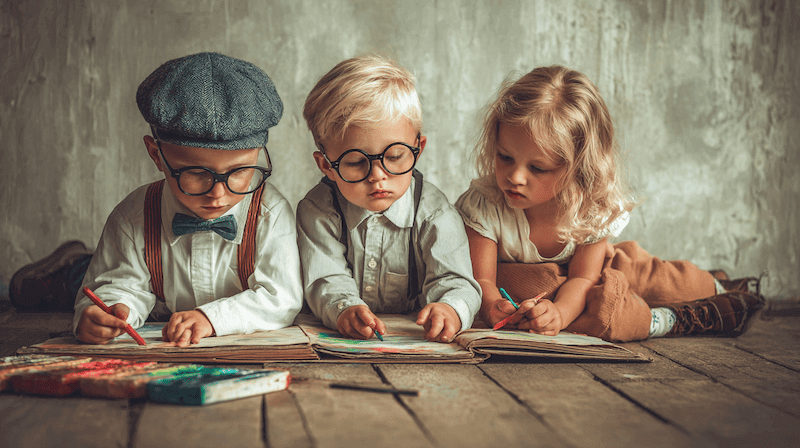
Neuroplasticity is a fancy word that simply means the brain’s ability to change and reorganize itself. In children, this ability is at its peak, making it easier for them to pick up new skills and knowledge. Imagine your brain is like a sponge, soaking up all the new information it encounters. Children’s brains are like super sponges, ready to absorb everything they come across.
As we grow older, the plasticity of our brains decreases. This doesn’t mean that adults can’t learn new things, but it does mean that children have an advantage when it comes to learning quickly. Think of it like trying to mold clay — it’s easier to shape when it’s soft and pliable, just like a child’s brain is more moldable and adaptable.
- Children’s brains are constantly forming new connections and pathways, allowing them to make sense of the world around them. This flexibility in the brain gives children the ability to learn languages, solve math problems, and understand complex concepts with ease.
- When faced with a challenge, children’s brains can quickly adjust and adapt, finding new solutions and ways to overcome obstacles.
- Learning a new skill becomes second nature to children because their brains are primed for growth and development. They thrive on discovery and exploration, always eager to try something new.
So, next time you wonder why your child seems to be learning at lightning speed, remember that it’s all thanks to their amazing neuroplasticity. Embrace their curiosity and watch them soak up knowledge like a sponge!
Children are more curious and willing to explore new ideas and concepts
Have you ever noticed how children seem to be naturally curious about the world around them? They are constantly asking questions, wanting to know more about how things work, why things are the way they are, and what new ideas and concepts they can discover. This curiosity that children have is one of the main reasons why they learn faster than adults.
When children are curious, they are more motivated to explore new ideas and concepts. They have a sense of wonder and excitement that drives them to seek out knowledge and understanding. This sense of curiosity helps children to stay engaged and focused on learning, making it easier for them to absorb new information.
- Curiosity leads to exploration: Children’s natural curiosity leads them to explore new ideas and concepts. They are eager to learn about the world around them, which keeps them engaged in the learning process.
- Curiosity drives motivation: When children are curious about a particular topic, they are more motivated to learn more about it. This motivation helps them to persevere through challenges and obstacles in their learning journey.
- Curiosity fosters creativity: Curious children are more likely to think outside the box and come up with innovative solutions to problems. Their willingness to explore new ideas helps them to develop critical thinking and problem-solving skills.
As children explore new ideas and concepts, they are building a strong foundation of knowledge and understanding. This foundation will serve them well as they continue to learn and grow throughout their lives. Encouraging and nurturing children’s curiosity is one of the best ways to support their learning and help them reach their full potential.
So, the next time you see a child asking questions and eager to learn more, remember that their curiosity is like a fuel that powers their learning journey. Let’s all take a lesson from children and stay curious, stay motivated, and stay open to exploring new ideas and concepts.
Children Have Fewer Preconceived Notions and Biases That Can Hinder Learning
Have you ever noticed how children seem more open to new ideas and concepts compared to adults? One of the reasons behind this is because children have fewer preconceived notions and biases that can sometimes get in the way of learning. Let’s break it down in a simpler way.
- When you hear about a new topic for the first time, your brain might automatically think about what you already know about it. Adults tend to rely on their past experiences and knowledge to make sense of things. This can sometimes lead to biases or misconceptions that can hinder the learning process. However, children don’t have as much prior knowledge to rely on, so they are more open to absorbing new information without any preconceived ideas getting in the way.
- Imagine trying to learn a new language. As an adult, you might constantly compare it to your native language or other languages you already know. This can make it challenging to fully immerse yourself in the new language and truly understand it. On the other hand, children approach language learning with a fresh perspective, making them more receptive to different sounds, words, and grammar rules without any preconceived notions holding them back.
- Similarly, when faced with a mathematical problem, adults might unconsciously stick to familiar methods or formulas that they learned in the past. This can limit their ability to think outside the box and explore alternative solutions. Children, on the other hand, are more willing to experiment and try out different approaches without feeling restricted by preexisting beliefs or assumptions.
In essence, the lack of preconceived notions and biases allows children to approach learning with a sense of openness and curiosity. They are like sponges, ready to soak up new knowledge without being weighed down by preconceptions. So, the next time you find yourself struggling to grasp a new concept, try to channel your inner child and embrace the wonder and enthusiasm that comes with learning without any baggage from the past.
Children: Open-Minded and Willing to Learn
One of the many reasons why children learn faster than adults is because they are more open-minded and willing to accept new information. Children have not yet formed strong beliefs or opinions about the world, so they are more receptive to new ideas and concepts.
- No Previous Biases: Children do not have as many preconceived notions or biases that can block their learning process. They approach new information with a fresh perspective, making it easier for them to absorb and understand.
- Willingness to Explore: Children are naturally curious beings. They have a thirst for knowledge and enjoy exploring new ideas. This sense of curiosity drives them to actively seek out information and engage with their surroundings.
- Less Fear of Failure: Children are not as afraid of making mistakes as adults are. They understand that making mistakes is a natural part of the learning process and are more willing to take risks in order to expand their knowledge and skills.
Because of their open-mindedness, children are able to approach learning with a sense of wonder and excitement. They are eager to discover new things and are not limited by preconceived notions or fears of failure. In this way, children are able to learn at a faster rate and absorb information more effectively.
As adults, we can learn from children by adopting a similar open-minded approach to learning. By being willing to explore new ideas, letting go of our fears of failure, and staying curious about the world around us, we can enhance our own learning experiences and continue to grow and develop throughout our lives.
Children tend to have better memory retention
One of the reasons why children learn faster than adults is because they have better memory retention. Have you ever noticed how a child can easily remember the lyrics to a song after hearing it just a few times? Or how they can quickly pick up new words and phrases in a different language?
This is because children’s brains are like sponges, soaking up information and storing it in their memory banks much more efficiently than adults. Their brains are constantly developing and forming new connections, making it easier for them to retain information.
- They have more neuroplasticity, allowing them to adapt and learn new information more quickly.
- They are more curious and willing to explore new ideas and concepts.
- They have fewer preconceived notions and biases that can hinder learning.
- They are more open-minded and willing to accept new information.
Children’s memory retention is also aided by their natural curiosity and enthusiasm for learning. When they are interested and engaged in a topic, they are more likely to remember details and concepts related to it. This is why children often have better recall of information learned through play, hands-on experiences, and interactive activities.
- They are more likely to learn through play and hands-on experiences.
- They have more energy and enthusiasm for learning, allowing them to focus for longer periods of time.
- They have less distractions and responsibilities compared to adults, giving them more time to dedicate to learning.
- They receive constant feedback and reinforcement from parents, teachers, and peers, motivating them to continue learning.
Additionally, children’s lack of self-consciousness and fear of making mistakes allow them to take risks in their learning without worrying about judgment or failure. They are more willing to try new things and push themselves out of their comfort zones, which can result in better memory retention and overall learning gains.
Overall, children’s superior memory retention plays a significant role in their ability to learn at a faster pace than adults. It is important for adults to recognize and utilize this strength when teaching and supporting children’s learning and development.
Children learn through play and hands-on experiences
Children have a natural curiosity and sense of wonder that leads them to learn best through play and hands-on experiences. When children are engaged in activities that are fun and interactive, they are more likely to retain information and develop new skills.
- Play allows children to explore and experiment in a safe and comfortable environment. Whether they are building with blocks, pretending to be superheroes, or solving puzzles, children are constantly learning and growing through play.
- Hands-on experiences give children the opportunity to use all of their senses to understand the world around them. By touching, feeling, seeing, and hearing new things, children are able to make connections and form memories that will stay with them long term.
When children are actively engaged in their learning, they are more likely to stay focused and attentive for longer periods of time. This type of experiential learning is not only effective, but it also fosters a love of learning that can last a lifetime.
As adults, we can support this type of learning by providing children with opportunities to explore, create, and discover on their own. By encouraging play and hands-on experiences, we are helping children develop important skills such as problem-solving, collaboration, and critical thinking.
So next time you see a child building a tower out of blocks or digging in the dirt, remember that they are not just playing – they are actively learning and growing in ways that will benefit them for years to come.
Children’s Energy and Enthusiasm for Learning
Have you ever noticed how children seem to have endless amounts of energy and enthusiasm when it comes to learning new things? It’s almost as if they have a natural zest for exploring the world around them and absorbing as much information as possible. This natural curiosity and excitement play a significant role in their ability to focus for long periods of time.
- First of all, children’s boundless energy levels allow them to stay engaged and focused on a task for much longer than adults. They can spend hours playing, learning, and discovering new things without becoming easily bored or distracted.
- Additionally, their enthusiasm for learning motivates them to persevere through challenges and setbacks. Whether they’re trying to master a new skill or understand a complex concept, children approach each task with a sense of excitement and determination.
- Moreover, their enthusiasm is infectious and can inspire them to immerse themselves fully in the learning process. When children are excited about a topic or a project, they are more likely to be actively involved and invested in their own learning.
Overall, children’s energy and enthusiasm for learning create the perfect environment for them to absorb new information and skills effectively. Their natural drive to explore, understand, and discover ensures that they are constantly engaged in the learning process, making it easier for them to focus for longer periods of time.
Children have less distractions and responsibilities compared to adults, giving them more time to dedicate to learning.
One of the reasons why children learn faster than adults is because they have fewer distractions and responsibilities. Unlike adults who juggle work, household chores, bills, and other obligations, children’s main focus is on school and extracurricular activities. This gives them more time and energy to dedicate to learning and exploring new ideas.
- Adults often find themselves multitasking and dividing their attention between various tasks, which can make it harder for them to fully concentrate on learning. Children, on the other hand, are typically able to focus better on one task at a time.
- Since children do not have to worry about paying bills or keeping up with deadlines, they can spend more time on educational activities such as reading, studying, and practicing skills. This additional time allows them to delve deep into subjects and develop a stronger understanding.
- Furthermore, because children have fewer responsibilities, they are able to engage in longer periods of focused learning. They can spend hours playing with educational toys, reading books, or working on projects without having to constantly switch their attention to other tasks.
- Additionally, children have more opportunities to participate in enriching experiences such as field trips, educational programs, and hands-on experiments. These experiences can enhance their learning and spark their curiosity in ways that can be challenging for busy adults to replicate.
Overall, the lack of distractions and responsibilities in children’s lives enables them to immerse themselves fully in the learning process. This undivided attention and dedication to learning are key factors in why children have the ability to absorb information at a faster pace than adults.
Children receive constant feedback and reinforcement
One of the key factors that contribute to children learning faster than adults is the constant feedback and reinforcement they receive from their parents, teachers, and peers. This supportive environment motivates children to continue learning and exploring new concepts.
- Parents: Parents play a crucial role in a child’s learning journey by providing encouragement, praise, and guidance. When children receive positive feedback from their parents, they are more likely to feel confident and motivated to keep learning. Parents can also help their children set goals and celebrate their achievements, further reinforcing the importance of learning.
- Teachers: In a classroom setting, teachers play a fundamental role in providing feedback and reinforcement to students. By giving constructive feedback, teachers help children understand their strengths and areas for improvement, encouraging them to strive for success. Teachers also create a positive learning environment where children feel supported and valued, fostering a love for learning.
- Peers: Peers can also provide valuable feedback and reinforcement to children. When children work together in groups or pairs, they can learn from each other’s experiences and ideas. Peer feedback helps children develop empathy, communication skills, and collaboration, all of which are essential for effective learning.
By receiving consistent feedback and reinforcement from various sources, children are encouraged to continue learning and growing. This positive reinforcement boosts their confidence, motivation, and self-esteem, creating a strong foundation for future learning experiences.
For adults, seeking feedback and reinforcement can also be beneficial in enhancing their learning experience. By surrounding themselves with supportive individuals who provide constructive feedback, adults can overcome challenges, build resilience, and achieve their learning goals.
Overall, the continuous support, feedback, and reinforcement that children receive from their parents, teachers, and peers play a vital role in their rapid learning and development. Encouraging a nurturing and positive learning environment can help adults enhance their learning experiences as well, leading to lifelong growth and self-improvement.
Children are more adaptable to different learning styles and teaching methods
One of the amazing things about children is their ability to adapt to different ways of learning. Whether it’s through visual aids, hands-on activities, or auditory cues, children have a natural knack for soaking up information in various ways.
Unlike adults who may be set in their ways, children are like sponges, ready to absorb whatever knowledge comes their way. Some kids may thrive on reading books, while others may excel in a hands-on environment where they can physically engage with the material. This flexibility allows for a more personalized learning experience that caters to each child’s unique strengths and preferences.
- Visual learners: Some children learn best through visual aids such as charts, graphs, and colorful images. These tools help them make connections and retain information more effectively.
- Auditory learners: Other children prefer listening to lectures, discussions, or songs to absorb new information. They may benefit from verbal cues and auditory stimuli to enhance their learning process.
- Kinesthetic learners: Some kids thrive on hands-on experiences and physical activities. These children learn by doing, whether it’s through experiments, art projects, or role-playing.
This adaptability extends not only to different learning styles but also to a variety of teaching methods. Children are open to trying new approaches and strategies to grasp a concept or solve a problem. Teachers and parents can leverage this flexibility to create engaging and dynamic lessons that cater to each child’s individual learning style.
By embracing diverse learning styles and teaching methods, children can discover the most effective way for them to absorb and retain information. This adaptability not only enhances their educational experience but also equips them with the skills necessary to navigate a rapidly changing world.
Children are less afraid of making mistakes and are more willing to take risks in their learning.
One of the reasons why children learn faster than adults is that they are less afraid of making mistakes. Children are naturally curious and love to explore new ideas and concepts without worrying about getting things wrong. They are not as self-conscious as adults, so they are more willing to take risks in their learning.
- No fear of failure: Children have a growth mindset that allows them to see mistakes as opportunities for learning and growth. They understand that making mistakes is a natural part of the learning process, and they are not afraid to fail.
- More willingness to try new things: Because children are not as concerned about making mistakes, they are more likely to try new things and take on challenges that stretch their abilities. This openness to trying new experiences helps them learn at a faster pace.
- Less perfectionism: Children are not obsessed with getting everything perfect on the first try. They are more focused on the process of learning and improving, rather than seeking perfection from the outset. This attitude allows them to progress more quickly.
When children are not afraid of making mistakes, they are more willing to experiment, explore, and push themselves beyond their comfort zones. This willingness to take risks in learning allows them to try different approaches, make connections, and discover new insights that contribute to their overall understanding.
As adults, we can learn a lot from children’s attitudes towards mistakes and risks in learning. By embracing a growth mindset, being open to new experiences, and letting go of the need for perfection, we too can accelerate our learning and develop new skills more rapidly.
Children’s rapid absorption of information
One of the key reasons why children learn faster than adults is because they are in a constant state of development and growth. Children’s brains are constantly growing and forming new connections, which allows them to absorb information at a faster rate compared to adults.
- Children’s brains are like sponges, soaking up new information and experiences every day. As they grow, their brains have the capacity to learn and adapt quickly, making it easier for them to grasp new concepts and ideas.
- Because children’s brains are still developing, they are able to process and retain information more efficiently. This rapid learning ability is known as neuroplasticity, which allows children to quickly adapt to new information and experiences.
It’s important to remember that children’s brains are not fully developed yet, and this is actually to their advantage when it comes to learning. Their brains are like blank slates, ready to absorb everything that comes their way. This is why children have an innate curiosity and willingness to explore the world around them.
As children grow and learn, their brains are constantly making new connections and forming pathways that help them make sense of the world. This ability to quickly make connections between different pieces of information is what allows children to learn at such a fast pace.
So, next time you wonder why your child seems to be learning so quickly, remember that their constant state of development and growth is the key factor. Their ability to absorb information at a rapid rate is a natural part of their brain’s growth and development.

 Subscribe to the newsletter







Сообщить об опечатке
Текст, который будет отправлен нашим редакторам: